

Biological control in the home garden
Biological control is the use of natural enemies to manage unwanted organisms. In the home garden this usually involves introducing predators or pathogenic nematodes.
Common name - Vine weevil
Scientific name - Otiorhynchus sulcatus
Plants affected - Ornamental plants and some fruits, especially those grown in containers
Main symptoms - Adult weevils notch leaf margins; grubs eat roots
Most active - Adult weevils spring to late summer; grubs summer to spring

Vine weevils are beetles with broad snouts, they can feed on a wide range of plants, both indoors and outdoors, but can be especially damaging to plants grown in containers. It is a very widespread and common insect. The adult weevils eat leaves during spring and summer, but it is the grubs that can cause the most damage over autumn and winter when they feed on plant roots. This damage can result in wilting and plant death. Adult vine weevils are mainly active after dark, during the day the beetles hide in leaf litter beneath their host plants.
Plants growing in pots and containers, outdoors or under cover, are most likely to be severely damaged by vine weevil grubs. Plants growing in the open ground are less likely to be damaged, although heavy populations of grubs can occur on strawberries, Primula, polyanthus, Sedum, Heuchera and young yew plants.
The adult beetles feed on the foliage of many herbaceous plants and shrubs, especially Rhododendron, Evergreen euonymus, Hydrangea, Epimedium, Bergenia, Primula and strawberry. Adults rarely cause enough damage to affect the vigour of plants.
There are 25 other species of weevil closely related to vine weevil, such as the privet weevil Otiorhynchus crataegi and the recently arrived O. armadillo. The adults of these other species cause similar damage but in gardens are usually less problematic as larvae. Unlike the vine weevil several of these other species have males and females and reproduce sexually.

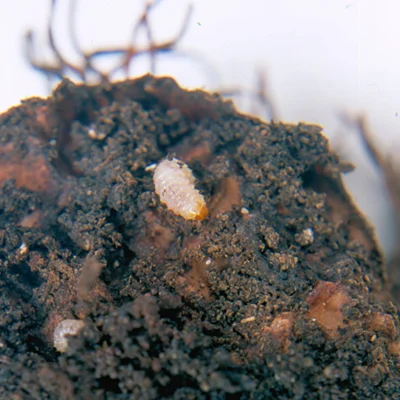
Vine weevil larvae, showing their small brown heads and C-shaped, legless bodies
You may see the following:
Vine weevil is a very widespread insect in Britain. Gardeners with vine weevil should keep up their guard because after the apparent disappearance of the weevil numbers can build up again, which can be problematic when susceptible plants are being grown.
Weevils are a group of several families of beetles in the superfamily Curculionoidea, there are more than 500 species in the UK. All feed on plant material, mostly live plants but a few feed on dry seeds (grain weevils) or rotting wood. Most do not cause noticeable damage to garden plants and several species are uncommon. Vine weevil is classified in a subfamily of weevil known as the broad nosed weevils (Entiminae), so called because of the broad snout (rostrum) these weevils have. There are over 100 species in this subfamily in Britain. More information on weevils from UK Beetles.
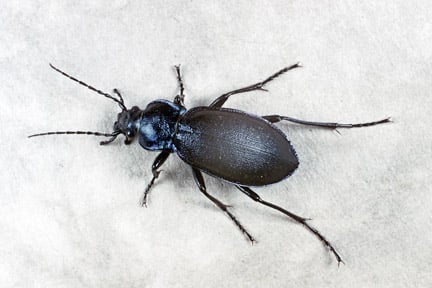
Adult vine weevils cause notch like leaf damage, however this rarely affects plant growth. The adults are 9mm (about 5/16in) long, dull black beetles with a pear-shaped body when viewed from above. Adult weevils may be seen on the foliage at night; during the day they hide in dark places. They are slow-moving insects that cannot fly but they are excellent crawlers and climbers. There are several other related species found in Britain which can cause similar damage to foliage as adults. Some that have recently become established include Otiorhynchus armadillo, O. crataegi and O. salicicola.
More serious is the damage can be caused by the soil-dwelling larvae, which are plump, white, legless grubs up to 10mm (about 3/8in) long with pale brown heads. These eat the roots of a wide range of plants and can bore into tubers of cyclamen and begonia, and into stem bases of cacti and . They can kill woody plants by gnawing away the outer tissues of the larger roots and stem bases. Most plant losses occur during September to March, when the grubs are becoming fully grown.
All Otiorhynchus sulcatus adults are female and each can lay several hundred eggs during spring and summer, reproducing asexually. This is not true for all Otiorhynchus species, for example O. armadillo is often found mating. The eggs are brown and less than 1mm (about 1/16in) in diameter, making them very difficult to see in soil. Larger yellowish-brown spherical objects seen in potting composts are likely to be controlled-release fertiliser pellets added by the nursery that raised the plants.