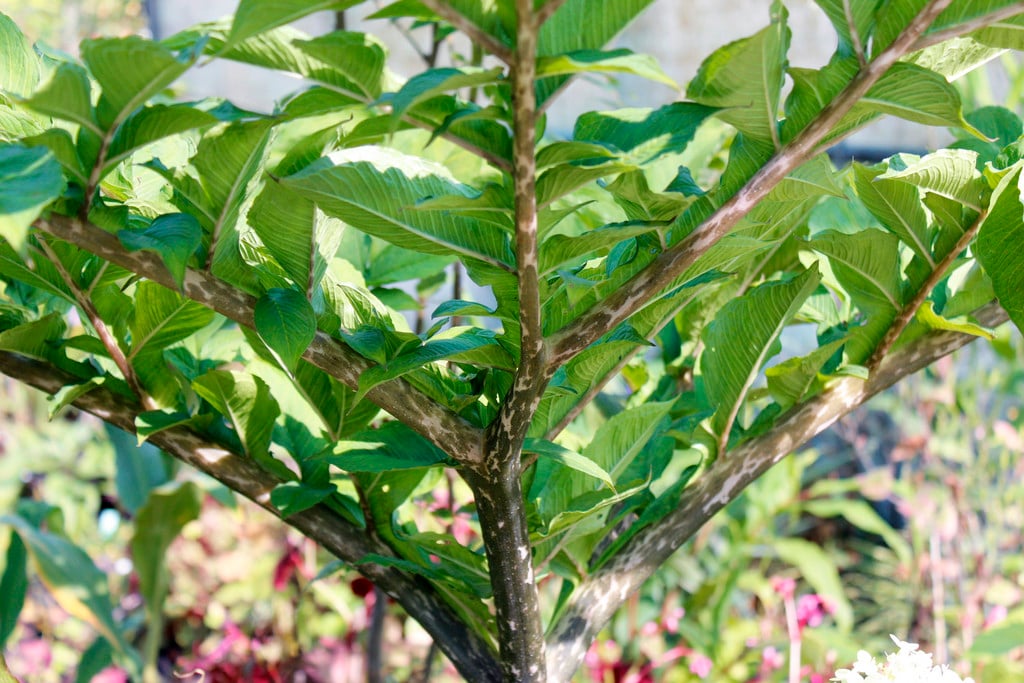
Amorphophallus konjac

RHS Plant Profile
konjaku
konjaku RHS

Other common names

konnyaku, devil's tongue, snake palm, umbrella arum

Synonyms

Amorphophallus rivieri

Conservatory Greenhouse Bulbs

A tuberous perennial producing a single flower in summer consisting of a shiny, red-purple spathe and tall, paddle-like, brown spadix. It has an unpleasant smell to attract pollinating flies.After the flower has faded a single, highly divided leaf appears with bright green leaflets and a stout, olive-green stem with white markings

Position

Partial shade

Soil Types

Loam

Max Height

1-1.5 metres

Max Spread

1-1.5 metres

Size

Time to Maturity
5–10 years
Max Spread
1-1.5 metres
Max Height
1-1.5 metres

Growing Conditions

Loam
Moisture
Moist but well–drained
pH
Acid or Alkaline or Neutral

Position

Partial shade
Aspect
West–facing or East–facing
Exposure
Sheltered
Hardiness
H1B

Colour & Scent

Fragrance Flower
Season Stem Flower Foliage Fruit
Spring
Summer
Autumn
Winter

Botanical Details

Family
Araceae
Native to GB/Ireland
No
Foliage
Deciduous
Habit
Columnar upright
Potentially harmful
Harmful if eatenskin/eye irritant. Wear gloves and other protective equipment when handling Pets: Harmful if eatenskin/eye irritant - see the HTA guide to potentially harmful plants for further information and useful contact numbers
Genus
Amorphophallus are perennials with corm-like rhizomes and huge, deeply-lobed leaves. The flowers are composed of a purple-red to greenish-white spathe, often unpleasantly-scented, and a central spadix
Name Status
Correct
Plant Range
Indonesia to Japan

How to Grow

Cultivation

Plant dormant tubers 10cm deep in late winter or early spring in a large container of peat-free, loam-based potting compost. Grow in filtered light, water and feed while in active growth, and overwinter in warm, barely moist conditions

Propagation

Separate offsets when dormant, or propagate by seed sown in heat in autumn or early spring

Suggested planting locations and garden types

  • Patio and container plants
  • Sub-tropical

Pruning

No pruning required

Pests

Generally pest-free

Diseases

Generally disease-free