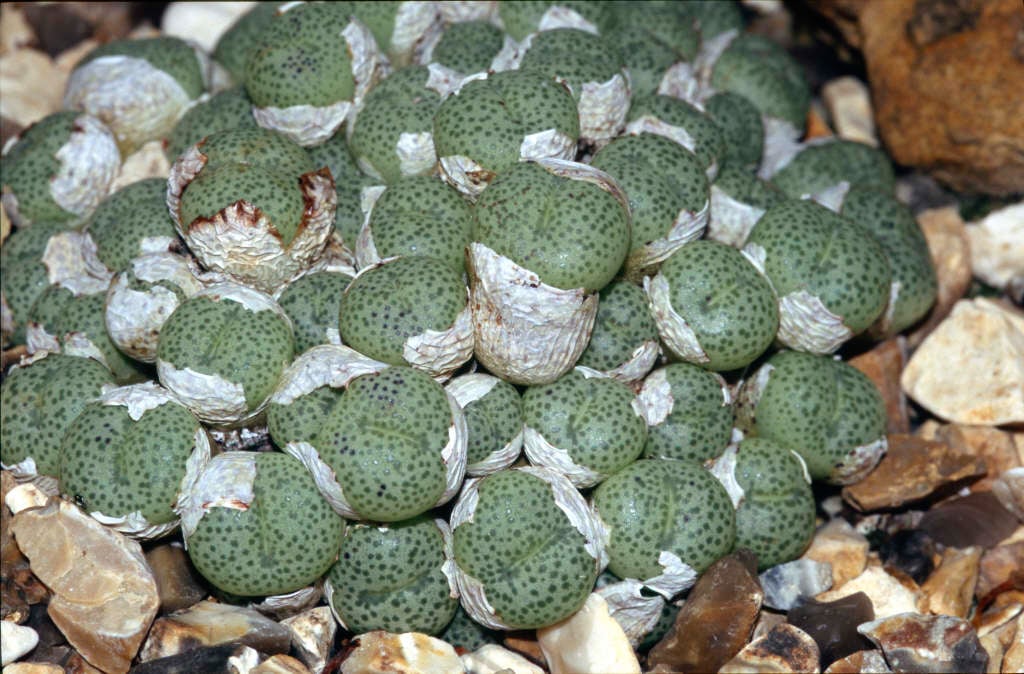
Conophytum flavum

RHS Plant Profile
yellow cone plant
yellow cone plant RHS

Synonyms

Conophytum ornatum
Conophytum luteum
Conophytum novicum
Conophytum rubristylosum

Award of Garden Merit
Cactus Succulent Conservatory Greenhouse Houseplants

A succulent perennial forming a clump of paired, partially united greyish leaves, with solitary pale to deep brown flowers in autumn

Position

Full sun

Soil Types

Loam, Sand

Max Height

Up to 10 cm

Max Spread

0-0.1 metre

Size

Time to Maturity
2–5 years
Max Spread
0-0.1 metre
Max Height
Up to 10 cm

Growing Conditions

Loam Sand
Moisture
Well–drained
pH
Acid or Alkaline or Neutral

Position

Full sun
Aspect
South–facing or North–facing or West–facing or East–facing
Exposure
Sheltered
Hardiness
H2

Colour & Scent

Season Stem Flower Foliage Fruit
Spring
Summer
Autumn
Winter

Botanical Details

Family
Aizoaceae
Native to GB/Ireland
No
Foliage
Evergreen
Habit
Bushy
Genus
Conophytum are dwarf succulent perennials forming clumps of "bodies" comprising a pair of very fleshy leaves, united in the lower part, with solitary daisy-like flowers appearing from the central fissure; the leaves usually shrivel after flowering
Name Status
Correct
Plant Range
S Africa (NW Cape)

How to Grow

Cultivation

Grow under glass in a mixture of two parts each sharp sand and loam and one part leaf mould, in full light. Provide low humidity. Water sparingly when in growth and keep completely dry at other times. No additional fertilizer is needed

Propagation

Propagate by seed sown in gentle heat with high humidity reduce the humidity after germination. Propagate by offsets may be taken

Suggested planting locations and garden types

  • Patio and container plants

Pruning

No pruning required

Pests

May be susceptible to aphids

Diseases

Generally disease-free