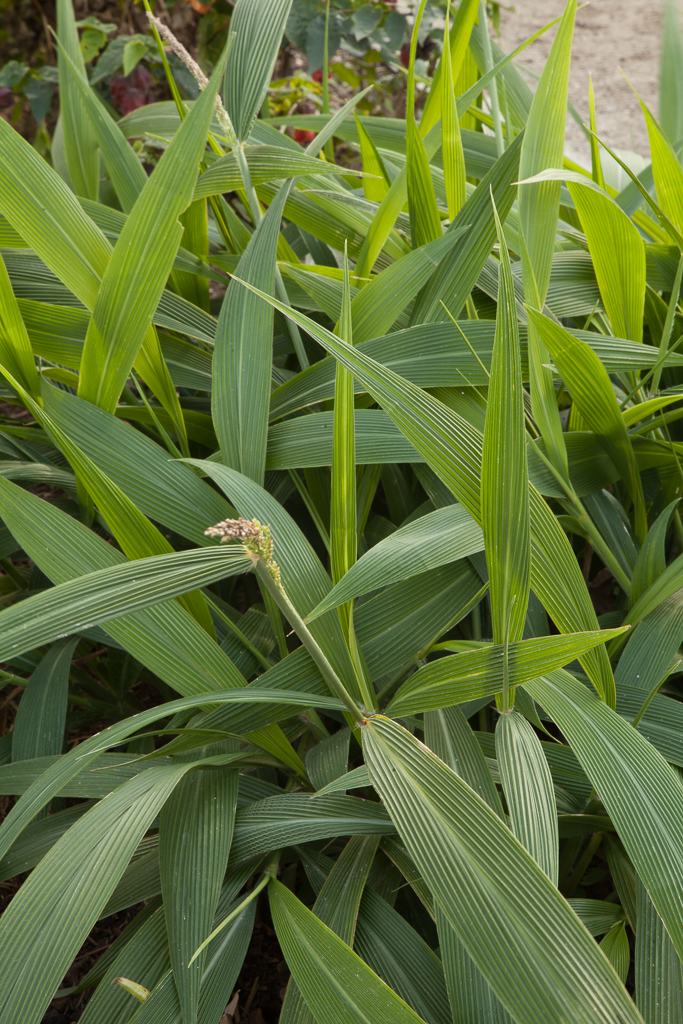
Setaria palmifolia

RHS Plant Profile
palm grass

Synonyms

Setaria paniculifera
Chaetochloa palmifolia

Award of Garden Merit
Grass Like

An upright to spreading, tender perennial grass, with pleated, elliptic to lance-shaped green leaves to 45cm long. Produces fine sprays of greenish tan flowers on arching stems in late summer. May be evergreen in warmer regions

Position

Full sun, Partial shade

Soil Types

Chalk, Clay, Loam, Sand

Max Height

1.5-2.5 metres

Max Spread

1.5-2.5 metres

Size

Time to Maturity
2–5 years
Max Spread
1.5-2.5 metres
Max Height
1.5-2.5 metres

Growing Conditions

Chalk Clay Loam Sand
Moisture
Moist but well–drained or Well–drained
pH
Acid or Alkaline or Neutral

Position

Full sun Partial shade
Aspect
East–facing or South–facing or West–facing
Exposure
Sheltered
Hardiness
H2

Colour & Scent

Season Stem Flower Foliage Fruit
Spring
Summer
Autumn
Winter

Botanical Details

Family
Poaceae
Native to GB/Ireland
No
Foliage
Semi evergreen
Habit
Clump forming
Genus
Setaria can be annual or perennial grasses, with linear to elliptic leaves and small flowers in a panicle, the spikelets with a tuft of conspicuous bristles
Name Status
Correct
Plant Range
Asia to Australia

How to Grow

Cultivation

May be grown outdoors in frost-free areas, otherwise best grown in a container or lifted to overwinter in a cool greenhouse or conservatory. Grow in any well-drained soil in full sun or partial shade

Propagation

Propagate by division in spring

Suggested planting locations and garden types

  • City and courtyard gardens
  • Cottage and informal garden
  • Patio and container plants
  • Sub-tropical
  • Low Maintenance
  • Conservatory and greenhouse
  • Flower borders and beds

Pruning

No pruning required

Pests

May be susceptible to red spider mites and caterpillars

Diseases

May be susceptible to rust diseases