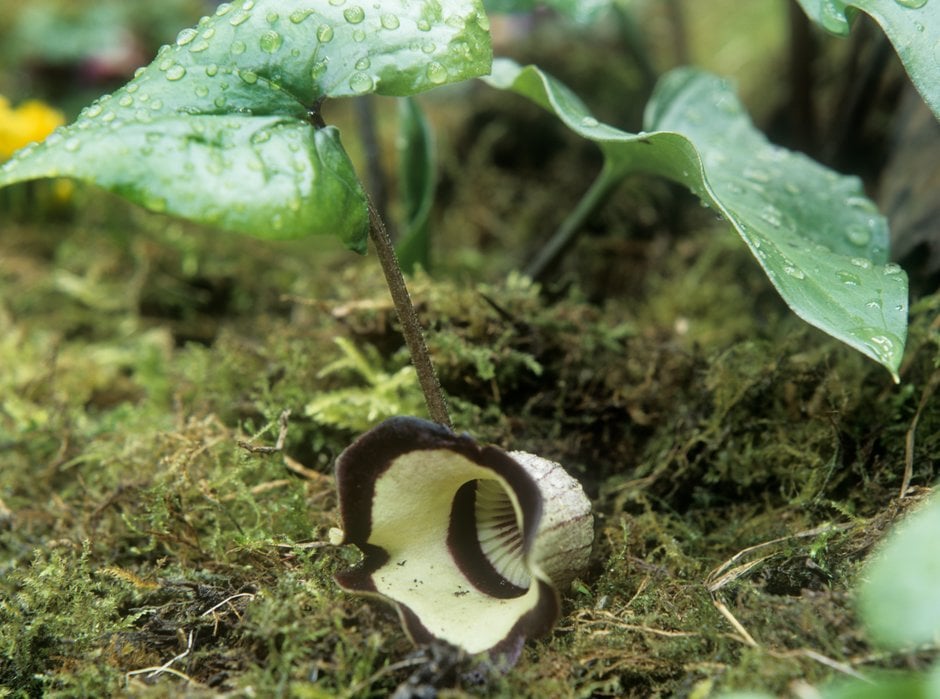
Asarum campaniflorum

RHS Plant Profile
bell-flowered wild ginger
bell-flowered wild ginger RHS

Synonyms

Asarum campaniforme hort.

Herbaceous Perennial

A rhizomatous, evergreen, mat-forming perennial to around 15cm high with shiny, dark green, heart-shaped leaves. Bell-shaped, solitary flowers are borne beneath the foliage at the base of the plant in late winter or early spring and are pale green to pale yellow with dark purple banding at the base and tips of the petals

Position

Full shade, Partial shade

Soil Types

Clay, Loam, Sand

Max Height

0.1-0.5 metres

Max Spread

0.1-0.5 metres

Size

Time to Maturity
2–5 years
Max Spread
0.1-0.5 metres
Max Height
0.1-0.5 metres

Growing Conditions

Clay Loam Sand
Moisture
Moist but well–drained
pH
Acid or Neutral

Position

Full shade Partial shade
Aspect
North–facing or West–facing or East–facing
Exposure
Sheltered
Hardiness
H6

Colour & Scent

Season Stem Flower Foliage Fruit
Spring
Summer
Autumn
Winter

Botanical Details

Family
Aristolochiaceae
Native to GB/Ireland
No
Foliage
Evergreen
Habit
Matforming
Potentially harmful
TOXIC if eaten. Wear gloves and other protective equipment when handling. TOXIC to pets if eaten - see the HTA guide to potentially harmful plants for further information and useful contact numbers
Genus
Asarum are evergreen or deciduous, rhizomatous perennials forming a mat of long-stalked, heart-shaped or kidney-shaped leaves, sometimes with attractive silver mottling, and curious flowers consisteng of a 3-lobed calyx, often in "earthy" colours. They are commonly referred to as wild gingers (they are not culinary gingers) but are so-called because their rhizomes have a similar spicy scent
Name Status
Correct

How to Grow

Cultivation

Grows best in woodland conditions - a humus-rich, moist but well-drained, acid to neutral soil and full to partial shade

Propagation

Propagate by seed sown in containers as soon as ripe, or divide in early spring

Suggested planting locations and garden types

  • Garden edging
  • Ground cover
  • Underplanting of roses and shrubs

Pruning

No pruning required

Pests

May be susceptible to slugs and snails

Diseases

Generally disease-free