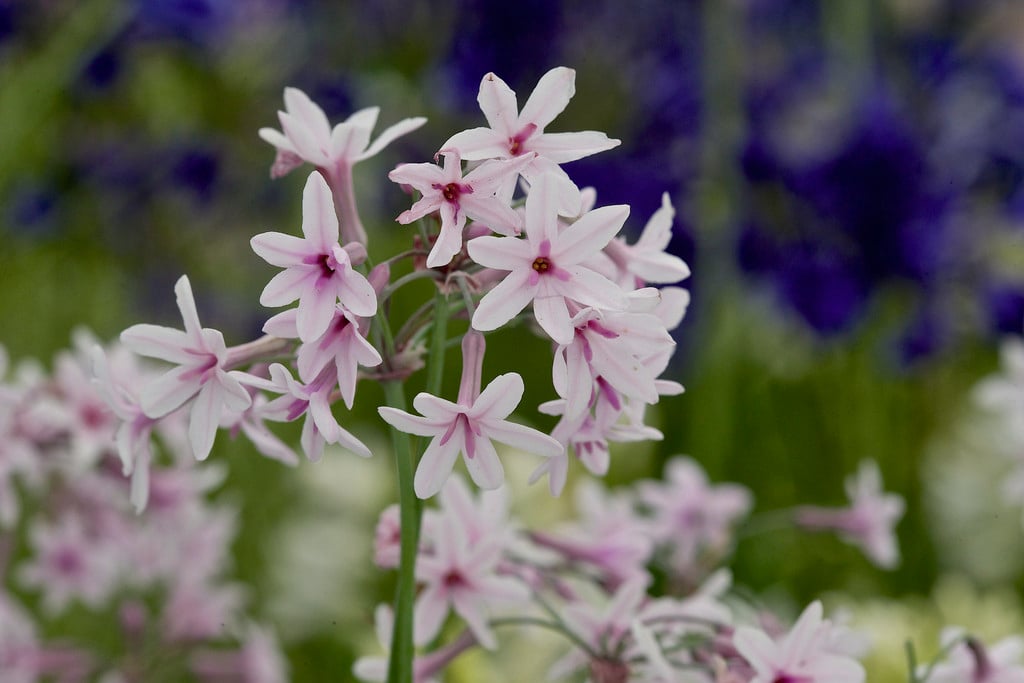
Tulbaghia 'Purple Eye'

RHS Plant Profile
society garlic 'Purple Eye'
society garlic 'Purple Eye' RHS

Synonyms

Tulbaghia 'Purple Eyes'

Award of Garden Merit
Bulbs Conservatory Greenhouse

A rhizomatous perennial growing to about 40cm. It has long, narrow, grey-green foliage with an oniony-smell when crushed. The flowers are tubular, with spreading petals giving a star-like effect, white or very pale purple with a mid-purple eye, and produced over a long period from early spring to early autumn

Position

Full sun

Soil Types

Loam, Sand

Max Height

0.1-0.5 metres

Max Spread

0.1-0.5 metres

Size

Time to Maturity
2–5 years
Max Spread
0.1-0.5 metres
Max Height
0.1-0.5 metres

Growing Conditions

Loam Sand
Moisture
Well–drained
pH
Acid or Alkaline or Neutral

Position

Full sun
Aspect
South–facing or West–facing or East–facing
Exposure
Sheltered
Hardiness
H2

Colour & Scent

Fragrance Foliage
Season Stem Flower Foliage Fruit
Spring
Summer
Autumn
Winter

Botanical Details

Family
Amaryllidaceae
Native to GB/Ireland
No
Foliage
Deciduous
Habit
Tufted
Genus
Tulbaghia are bulbous or rhizomatous perennials with linear, onion-scented leaves and umbels of small, star-shaped flowers with a small cup-like corona
Name Status
Accepted

How to Grow

Cultivation

Grow under glass in well-drained, loam-based compost in full light. Water freely when in growth, reduce water when in flower and again as leaves wither in autumn. Keep almost dry when dormant

Propagation

Propagate by division in spring

Suggested planting locations and garden types

  • Patio and container plants
  • Mediterranean climate plants

Pruning

Cut faded flowers to the base to prolong flowering

Pests

May be susceptible to aphids and glasshouse whitefly

Diseases

Generally disease-free