Quick facts
Common names - Bibionids, bibionid flies, St Mark's Fly
Scientific names - Bibio and Dilophus species
Plants affected - Potato, tomato, lettuce, hops, Chrysanthemum, Japanese anemones (Eriocapitella), larch (Larix), Rosa, Rheum, Polyanthus
Main symptoms - Larvae feeding on roots
Most active - April - October


What are bibionids?
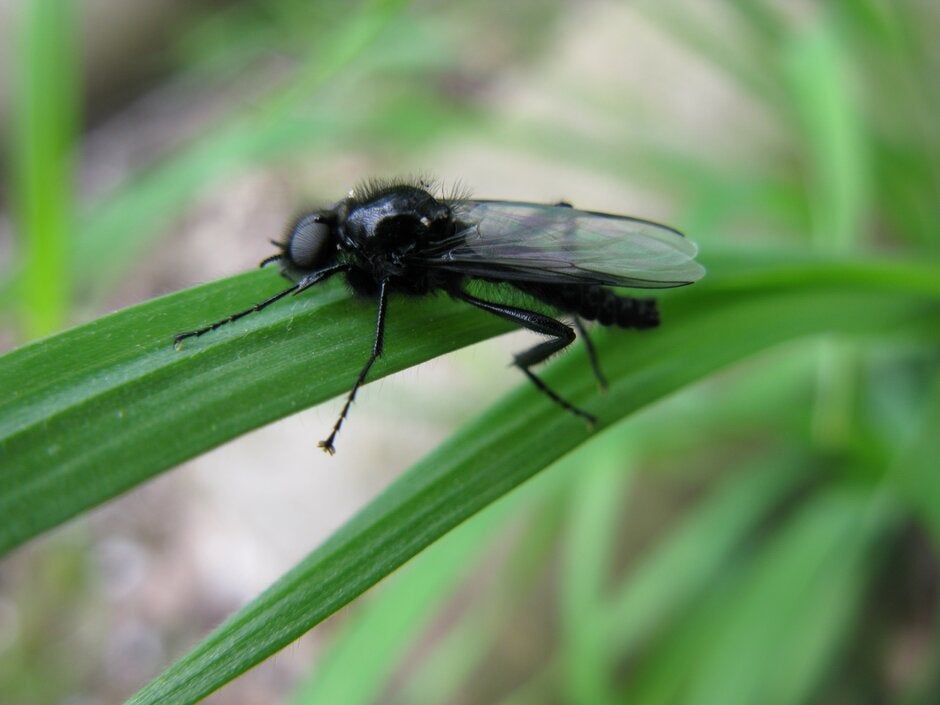
Bibionid flies are true flies belonging to the family Bibionidae, class Diptera. Bibionid flies are large, thick-set, blackish and hairy, especially the males, with short thick antennae. The eyes are not kidney-shaped in these flies, rather the males have ‘holoptic’ eyes meaning the eyes meet in the middle and each eye is divided into two parts. The eyes in the female flies are widely separated. The larvae have black heads and bristle like hairs which distinguish these larvae from most other flies.
Bibionid flies are quite abundant in Britain and Northern Ireland. There are two British genera, Bibio (16 species) and Dilophus (4 species). St Marks Fly Biobio merci and B. johannis are the two most common species of this family. St Mark’s fly is named after the fly’s flight period as it emerges around St Mark’s Day, 25th April. The male St Marks Flies are commonly seen dancing in swarms in bright sunshine. Both B. merci and B. johannis are 5 – 10 mm long, black with hairy head and legs, and may have reddish brown legs and/or abdomens. Each wing of the male B. johannis fly has a dark stigma and the lower part of the legs are orange, which can be used to distinguish B. johannis from St Marks Fly. Some other common bibionid species are Dilophus febrilis, blossom fly, and B. pomonae, heather fly. The larger species such as St Mark’s fly are the more conspicuous but smaller ones such as B. johannis and D. febrilis are also very abundant.
Symptoms
Look out for:
- The male St Mark's Flies, which are commonly seen dancing in swarms in bright sunshine in late April
- The larvae of bibionid flies feed on decaying organic matter and they are sometimes found in large numbers under piles of leaf litter and other rotting vegetation. The larvae can occasionally feed on the roots of hops, chrysanthemum, larch, celery, and rose, tomato and potato tubers. In these cases, the feeding is usually initiated by other animals such as slugs and snails or a disease
- Adult bibionid flies can visit flowers to drink and can help in pollinating trees
Management
Both the adults and larvae are food source for birds, such as swifts, pheasants, and partridges. The adult flies only live for a few days and may not feed at all, so do not cause damage to plants and do not bite, so are part of the wildlife that gardens support
Bibionid fly larvae feed on decaying organic matter and the adult flies such as blossom fly D. febrilis are important fruit-tree pollinators. So, these flies are part of a healthy garden ecosystem, and should not be managed. Bibionid flies rarely initiate plant damage.
Where bibionid fly larvae are found in plant roots and potato tubers, stems can be taken to minimize slug and snail populations. Sometimes, larvae can be found in lawns as they can get attracted to rotting turf, which is usually caused by waterlogging. In that case, improving drainage to reduce waterlogging and improve the health of the lawn will deter bibionid larvae.
Biology
Adult bibionid flies are often seen in large numbers, the males flying in a rising and falling dancing flight in bright sunshine, over grasslands and along the edges of woodland, with their hind legs hanging down. Swarming behaviour can be divided into two types: true aerial swarms, typical of Bibio and mass accumulations on low vegetation, typical of Dilophus species. In B. pomonae the males usually fly 1-2 m from heather covered ground whereas B. merci, common in lowland areas, can be seen flying up to 5-6 m high between large bushes. Male Dilophus often display a slow hovering flight 30-50 cm above ground, with the abdomen held in a characteristic horizontal position. Some mass emergence of Dilophus may cover many square meters of grasslands with rows of males clinging to majority of grass stems.
After mating, the females dig down into the soil using their strong front legs. They construct a small cell at a depth of 3-5 cm or more and deposit 200-300 cylindrical eggs in the cell. After this, the flies die, usually just outside the egg cell. The males do not survive long after mating.
The eggs hatch after about one month into legless caterpillar-like larvae, which are not very active and tend to be gregarious. Fully grown larvae can be up to 2—24 mm in the larger species such as the St Marks Fly. The larvae form chambers in the soil in which they pupate. The adult flies emerge from the pupae in three weeks and dig their way out of the soil.