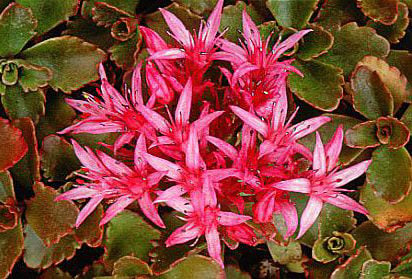
Sedum spurium 'Schorbuser Blut'

RHS Plant Profile
Caucasian stonecrop 'Schorbuser Blut'
Caucasian stonecrop 'Schorbuser Blut' Dorling Kindersley 2003

Other common names

crimson stonecrop 'Schorbuser Blut'

Synonyms

Sedum spurium 'Dragon's Blood'
Sedum 'Schorbuser Blut'
Phedimus spurius 'Dragon's Blood'
Sedum spurium Dragon's Blood

Award of Garden Merit
Cactus Succulent Herbaceous Perennial

'Schorbuser Blut' is a mat-forming evergreen perennial to 10cm in height, with fleshy, obovate, purple-tinged leaves and flat clusters of small, starry deep reddish-pink flowers in late summer

Position

Full sun

Soil Types

Loam, Sand

Max Height

Up to 10 cm

Max Spread

0.1-0.5 metres

Size

Time to Maturity
2–5 years
Max Spread
0.1-0.5 metres
Max Height
Up to 10 cm

Growing Conditions

Loam Sand
Moisture
Well–drained
pH
Acid or Alkaline or Neutral

Position

Full sun
Aspect
South–facing or West–facing
Exposure
Sheltered
Hardiness
H7

Colour & Scent

Season Stem Flower Foliage Fruit
Spring
Summer
Autumn
Winter

Botanical Details

Family
Crassulaceae
Native to GB/Ireland
No
Foliage
Evergreen
Habit
Matforming
Genus
Sedum may be annuals or herbaceous or evergreen perennials with succulent stems and leaves and clusters of small, star-shaped flowers in summer or autumn
Name Status
Accepted

How to Grow

Cultivation

Grow in a sheltered position in moderately fertile, well-drained, alkaline to neutral soil in full sun. See hardy cacti and succulent cultivation for further advice

Propagation

Propagate by division in spring or by softwood cuttings in early summer

Suggested planting locations and garden types

  • Cottage and informal garden
  • Gravel garden
  • Rock garden
  • Flower borders and beds
  • Garden edging
  • Ground cover

Pruning

No pruning required

Pests

May be susceptible to slugs, snails, vine weevil grubs, scale insects and mealybugs

Diseases

May be susceptible to fungal and bacterial crown and root rots