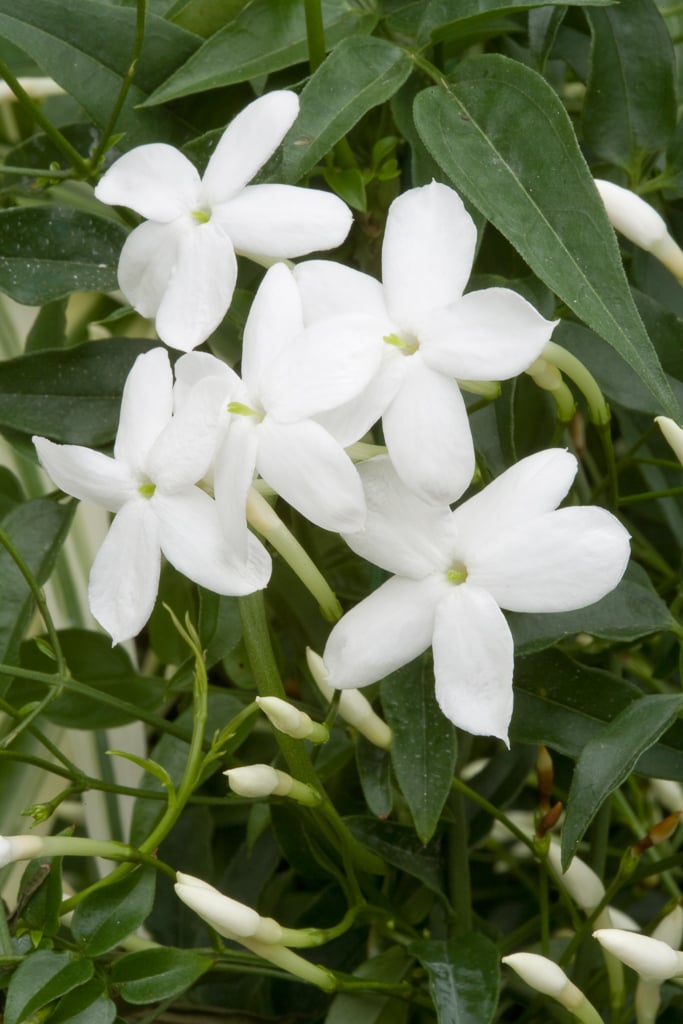
Jasminum grandiflorum L.

RHS Plant Profile
Catalonian jasmine
Catalonian jasmine John Fielding

Other common names

royal jasmine, Spanish jasmine, large-flowered jasmine

Award of Garden Merit
Climber Wall Shrub

A semi-evergreen or decidous woody, twining climber with compound glossy-green pinnate leaves comprising of 7 to 9 opposite leaflets. Has pink-tinged buds opening to very fragrant 5cm white flowers from summer to autumn.

Position

Full sun, Partial shade

Soil Types

Chalk, Clay, Loam, Sand

Max Height

8-12 metres

Max Spread

2.5-4 metres

Size

Time to Maturity
5–10 years
Max Spread
2.5-4 metres
Max Height
8-12 metres

Growing Conditions

Chalk Clay Loam Sand
Moisture
Moist but well–drained
pH
Acid or Alkaline or Neutral

Position

Full sun Partial shade
Aspect
South–facing or West–facing
Exposure
Sheltered
Hardiness
H4

Colour & Scent

Season Stem Flower Foliage Fruit
Spring
Summer
Autumn
Winter

Botanical Details

Family
Oleaceae
Native to GB/Ireland
No
Foliage
Deciduous, Semi evergreen
Habit
Climbing
Genus
Jasminum are evergreen or deciduous shrubs, many climbing by twining stems bearing usually pinnate leaves, and star-shaped white, pink or yellow flowers, which are sometimes very fragrant. Fruit a black berry
Name Status
Correct
Plant Range
SW Arabia

How to Grow

Cultivation

Grow in full sun or partial shade, moist, well-drained fertile soil, avoiding water-logging. It will underperform during prolonged drought, shade or cool wet conditions.

Propagation

By layering or semi-hard wood cuttings.

Suggested planting locations and garden types

  • City and courtyard gardens
  • Coastal
  • Cottage and informal garden
  • Climber and wall shrubs
  • Flower borders and beds
  • Wall side borders

Pruning

Immediately after flowering, remove dead, damaged or diseased stems.

Pests

May be susceptible to spider mites.

Diseases

May be susceptible to honey fungus (rarely)