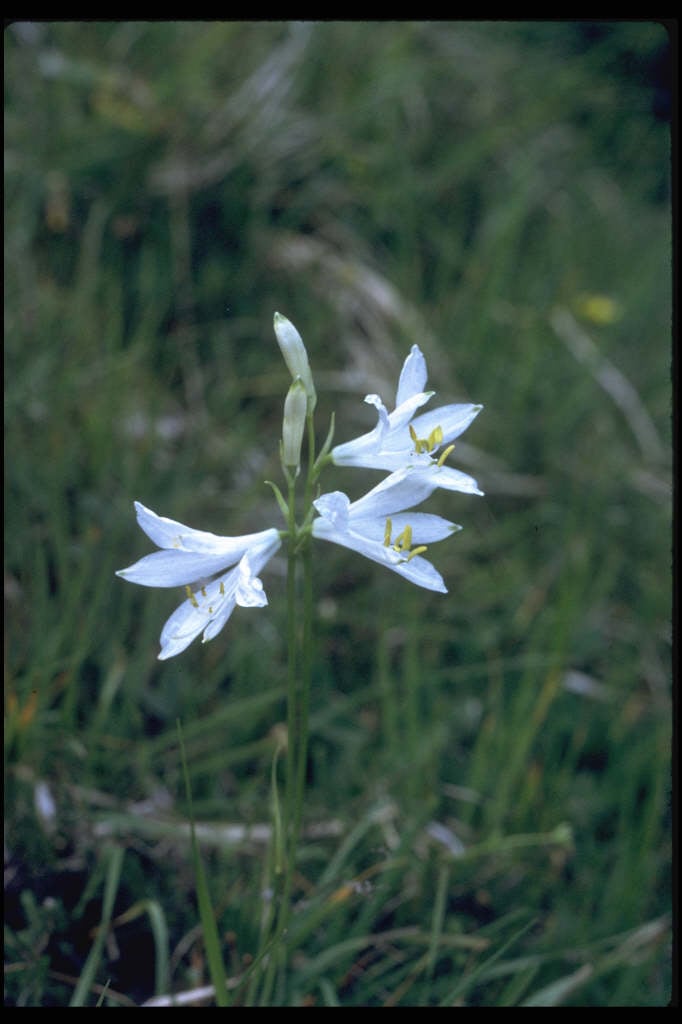
Paradisea liliastrum (L.) Bertol.

RHS Plant Profile
St Bruno's lily
St Bruno's lily RHS 1971

Other common names

giant St Bruno's lily, great Savoy spiderwort, paradise lily, star lily of paradise

Synonyms

Anthericum liliastrum

Award of Garden Merit
Herbaceous Perennial

A clump-forming herbaceous perennial to 60cm in height, with greyish-green grassy leaves and erect stems bearing racemes of lily-like pure white flowers 4-6cm in length in early summer

Position

Full sun, Partial shade

Soil Types

Chalk, Clay, Loam, Sand

Max Height

0.5-1 metres

Max Spread

0.1-0.5 metres

Size

Time to Maturity
2–5 years
Max Spread
0.1-0.5 metres
Max Height
0.5-1 metres

Growing Conditions

Chalk Clay Loam Sand
Moisture
Moist but well–drained
pH
Acid or Alkaline or Neutral

Position

Full sun Partial shade
Aspect
South–facing or East–facing or West–facing
Exposure
Exposed or Sheltered
Hardiness
H5

Colour & Scent

Fragrance Flower
Season Stem Flower Foliage Fruit
Spring
Summer
Autumn
Winter

Botanical Details

Family
Asparagaceae
Native to GB/Ireland
No
Foliage
Deciduous
Habit
Clump forming
Genus
Paradisea are clump-forming, rhizomatous, herbaceous perennials with linear basal leaves and stems bearing loose racemes of trumpet-shaped white flowers in late spring or summer
Name Status
Correct
Plant Range
Pyrenees, Alps, Appennines

How to Grow

Cultivation

Grow in humus-rich soil in full sun or partial shade

Propagation

Propagate by seed sown in pots in a cold frame either when ripe or in spring. Propagate by division after flowering or in early spring

Suggested planting locations and garden types

  • Cottage and informal garden
  • City and courtyard gardens
  • Low Maintenance
  • Flower borders and beds

Pruning

Deadhead after flowering to maintain vigour and then cut back to base in winter

Pests

May be susceptible to slugs

Diseases

Generally disease-free