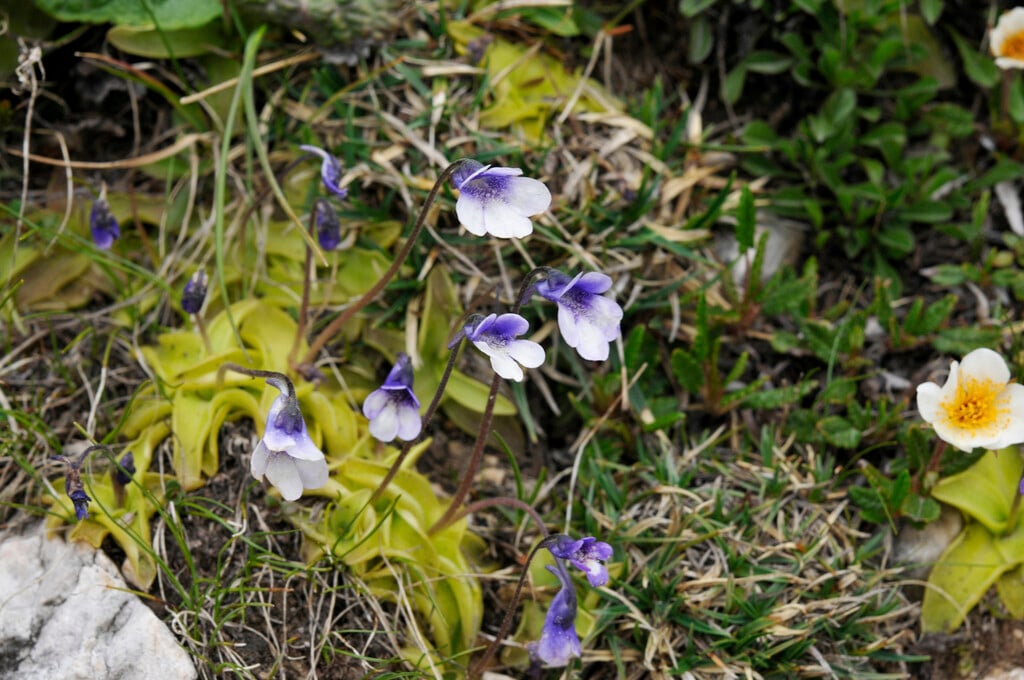
Pinguicula vulgaris

RHS Plant Profile
common butterwort
common butterwort visionspictures.com

Other common names

beanweed, bog violet, butter root, eccle grass, rot grass, rots, sheep root, sheeprot, sheepweed, steep grass, Yorkshire fog, Yorkshire sanicle, toddyn cyffredin

Bogs Herbaceous Perennial

A perennial, carniverous plant with low-growing, pale yellow-green leaves which form a star-shaped rosette and excrete a sticky substance to attract and capture prey, curling up to keep the prey inside. Bright purple, funnel-shaped flowers with a speckled white interior appear from May to July. Thrives in damp and boggy locations

Position

Full sun, Partial shade

Soil Types

Clay, Loam, Sand

Max Height

0.1-0.5 metres

Max Spread

0-0.1 metre

Size

Time to Maturity
2–5 years
Max Spread
0-0.1 metre
Max Height
0.1-0.5 metres

Growing Conditions

Clay Loam Sand
Moisture
Moist but well–drained or Poorly–drained
pH
Acid or Neutral

Position

Full sun Partial shade
Aspect
East–facing or South–facing or West–facing
Exposure
Sheltered
Hardiness
H6

Colour & Scent

Season Stem Flower Foliage Fruit
Spring
Summer
Autumn
Winter

Botanical Details

Family
Lentibulariaceae
Native to GB/Ireland
Yes
Foliage
Deciduous
Habit
Clump forming
Genus
Pinguicula are a genus of around 80 species of, mainly perennial, flowering carnivorous plants with sticky leaves which attract and digest insects. Leaves are succulent-like and flowers mainly blue, violet or white
Name Status
Correct

How to Grow

Cultivation

Grow in a compost mix comprising one part each peat substitute, coarse sand, perlite and dolomitic limestone chippings. Position in bright, filtered light. In growth, water freely; in winter water sparingly. See carnivorous plant cultivation for further advice

Propagation

Propagate by seed sown as soon as ripe on the surface of damp sphagnum moss with gentle heat, or separate resting buds in late winter

Suggested planting locations and garden types

  • Houseplants
  • Conservatory and greenhouse

Pruning

No pruning required

Pests

Generally pest-free

Diseases

Generally disease-free