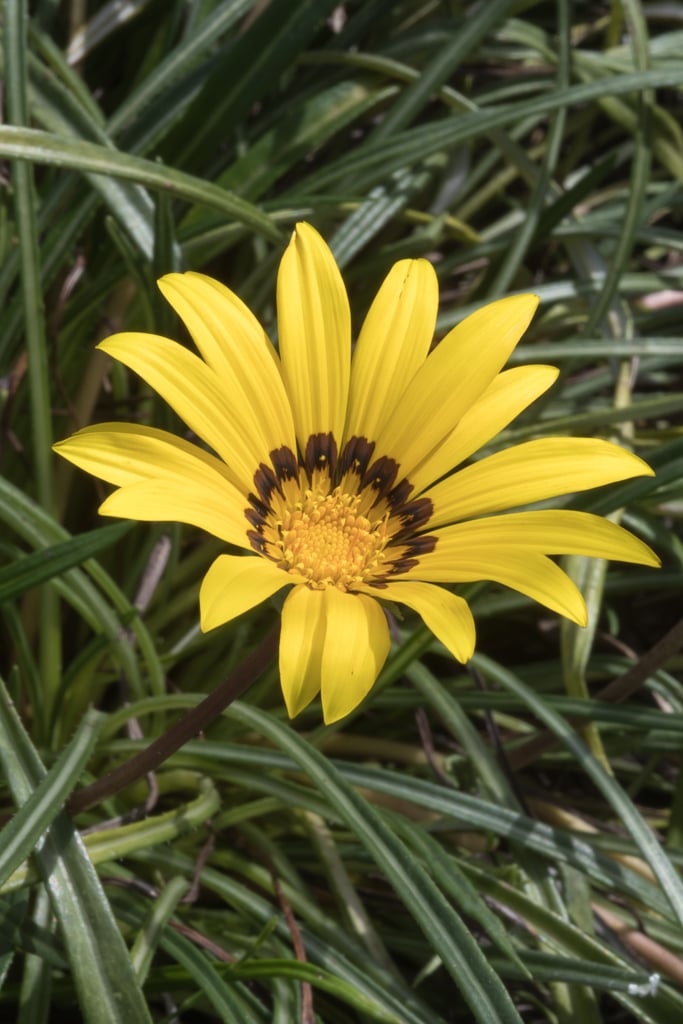
Gazania linearis

RHS Plant Profile
narrow-leaved treasure flower
narrow-leaved treasure flower John Fielding
Bedding Herbaceous Perennial

A mat-forming, evergreen perennial with basal rosettes of linear to lance-shaped leaves with white, woolly undersides arising from a stout woody crown and flowers that close up in dull weather. The solitary, daisy-like flowerheads up to 8cm in diameter are borne from spring into summer but may appear intermittently throughout the year in frost-free climates and comprise golden-yellow to orange ray florets often with dark spots near their bases surrounding a reddish-orange central disc

Position

Full sun

Soil Types

Loam, Sand

Max Height

0.1-0.5 metres

Max Spread

0.1-0.5 metres

Size

Time to Maturity
1–2 years
Max Spread
0.1-0.5 metres
Max Height
0.1-0.5 metres

Growing Conditions

Loam Sand
Moisture
Moist but well–drained
pH
Acid or Alkaline or Neutral

Position

Full sun
Aspect
South–facing or West–facing or East–facing
Exposure
Sheltered
Hardiness
H2

Colour & Scent

Season Stem Flower Foliage Fruit
Spring
Summer
Autumn
Winter

Botanical Details

Family
Asteraceae
Native to GB/Ireland
No
Foliage
Evergreen
Habit
Matforming
Genus
Gazania can be annuals or evergreen perennials, of spreading habit, with lobed lance-shaped leaves and showy daisy-like flowers which close in dull weather
Name Status
Correct

How to Grow

Cultivation

Grow in moderately fertile, well-drained soil in full sun. Flowers close when shaded. Deadhead regularly to prolong flowering. Will survive winter outdoors in mild areas. Water in prolonged dry spells

Propagation

Propagate by softwood cuttings taken from the base of shoots in late summer and kept in frost free conditions over winter

Suggested planting locations and garden types

  • Coastal
  • Cottage and informal garden
  • Gravel garden
  • Patio and container plants
  • Rock garden
  • Flower borders and beds

Pruning

No pruning required. Deadhead regularly

Pests

Generally pest-free except for aphids when overwintered indoors

Diseases

Generally disease-free but may be susceptible to stem and root rots in overly moist soils