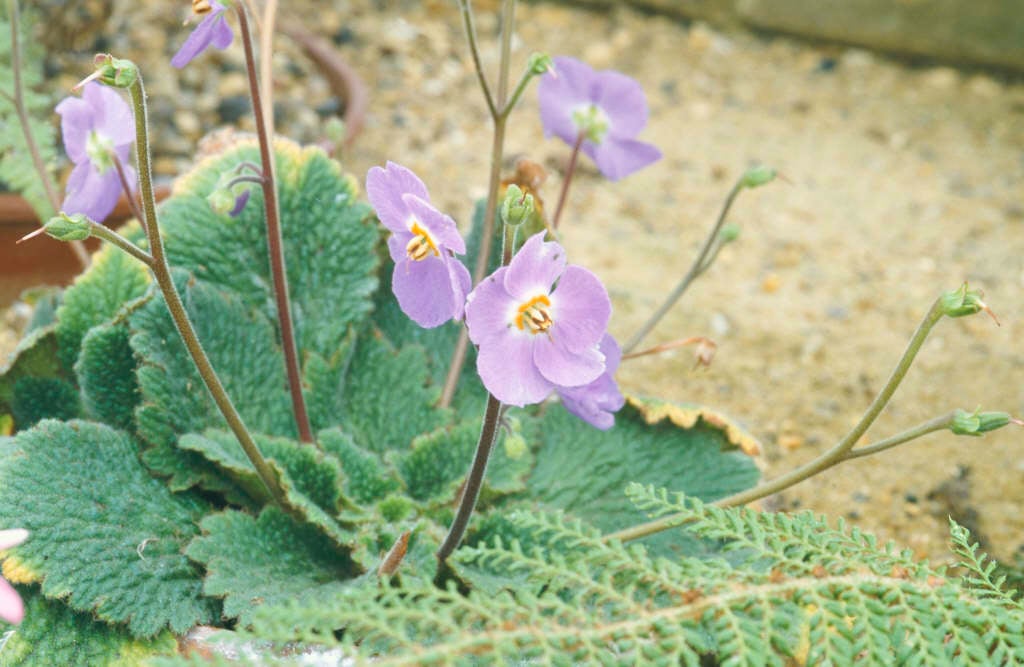
Ramonda myconi

RHS Plant Profile
Pyrenean violet
Pyrenean violet RHS 2002

Other common names

rosette mullein

Synonyms

Ramonda pyrenaica

Award of Garden Merit
Alpine Rockery

An evergreen perennial to 10cm in height, forming a rosette of broadly ovate, hairy, dark green leaves. Flowers 2.5cm in width, with five rounded violet-blue petals and yellow anthers, in clusters on leafless stems

Position

Partial shade

Soil Types

Chalk, Loam, Sand

Max Height

Up to 10 cm

Max Spread

0.1-0.5 metres

Size

Time to Maturity
2–5 years
Max Spread
0.1-0.5 metres
Max Height
Up to 10 cm

Growing Conditions

Chalk Loam Sand
Moisture
Moist but well–drained
pH
Acid or Alkaline or Neutral

Position

Partial shade
Aspect
North–facing or West–facing or East–facing or South–facing
Exposure
Exposed or Sheltered
Hardiness
H5

Colour & Scent

Season Stem Flower Foliage Fruit
Spring
Summer
Autumn
Winter

Botanical Details

Family
Gesneriaceae
Native to GB/Ireland
No
Foliage
Evergreen
Habit
Clump forming
Genus
Ramonda are evergreen perennials forming rosettes of crinkled, hairy leaves, with solitary or clustered flowers in late spring and early summer
Name Status
Correct
Plant Range
Pyrenees to NE Spain

How to Grow

Cultivation

Grow in moderately fertile, humus-rich, moist but well-drained soil in partial shade. Plants grow best on their sides to avoid accumulations of moisture in the rosettes, which may cause rotting in winter

Propagation

Propagate by seed or root leaf cuttings in early autumn

Suggested planting locations and garden types

  • Patio and container plants
  • Rock garden

Pruning

No pruning required

Pests

May be susceptible to slugs and snails

Diseases

Generally disease-free