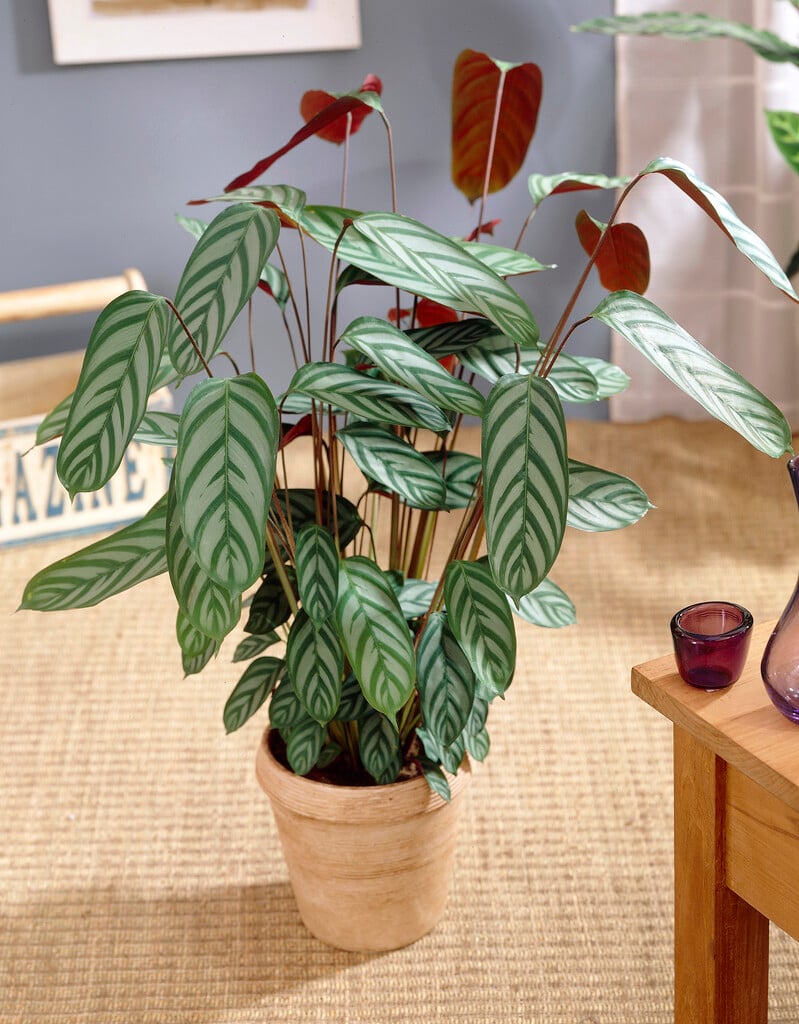
Ctenanthe 'Compactstar'PBR

RHS Plant Profile
ctenanthe 'Compactstar'
ctenanthe 'Compactstar' visionspictures.com
Conservatory Greenhouse Houseplants

A tender, evergreen perennial to about 40-50cm tall, with softly hairy purple-tinged green stems bearing oblong to ovate pale silvery-green leaves, marked with a dark grey-green herringbone pattern, and purple beneath. White flower spikes may be borne intermittently throughout the year

Position

Partial shade

Soil Types

Loam

Max Height

0.1-0.5 metres

Max Spread

0.1-0.5 metres

Size

Time to Maturity
5–10 years
Max Spread
0.1-0.5 metres
Max Height
0.1-0.5 metres

Growing Conditions

Loam
Moisture
Moist but well–drained
pH
Acid or Alkaline or Neutral

Position

Partial shade
Aspect
East–facing or West–facing
Exposure
Sheltered
Hardiness
H1B

Colour & Scent

Season Stem Flower Foliage Fruit
Spring
Summer
Autumn
Winter

Botanical Details

Family
Marantaceae
Native to GB/Ireland
No
Foliage
Evergreen
Habit
Bushy
Genus
Ctenanthe are bushy evergreen perennials grown for their usually strikingly patterned, lance-shape to obovate leaves; irregular and usually inconspicuous tubular white or yellow flowers are borne in short racemes intermittently throughout the year
Name Status
Accepted

How to Grow

Cultivation

Grow indoors in a peat-free, loam-based potting compost (JI No.2) in bright, indirect light. Water freely and apply a general liquid fertiliser monthly from spring to summer. Provide high humidity by placing the container on a tray of moist gravel. Water to keep compost moist in winter, and keep draught-free at a constant temperature. Repot annually in late spring or early summer. See houseplant cultivation for further advice

Propagation

Propagate by seed sown at 19 to 24°C in spring as soon as ripe, or by division in spring

Suggested planting locations and garden types

  • Houseplants
  • Sub-tropical
  • Conservatory and greenhouse

Pruning

No pruning required

Pests

May be susceptible to mealybugs

Diseases

Generally disease-free