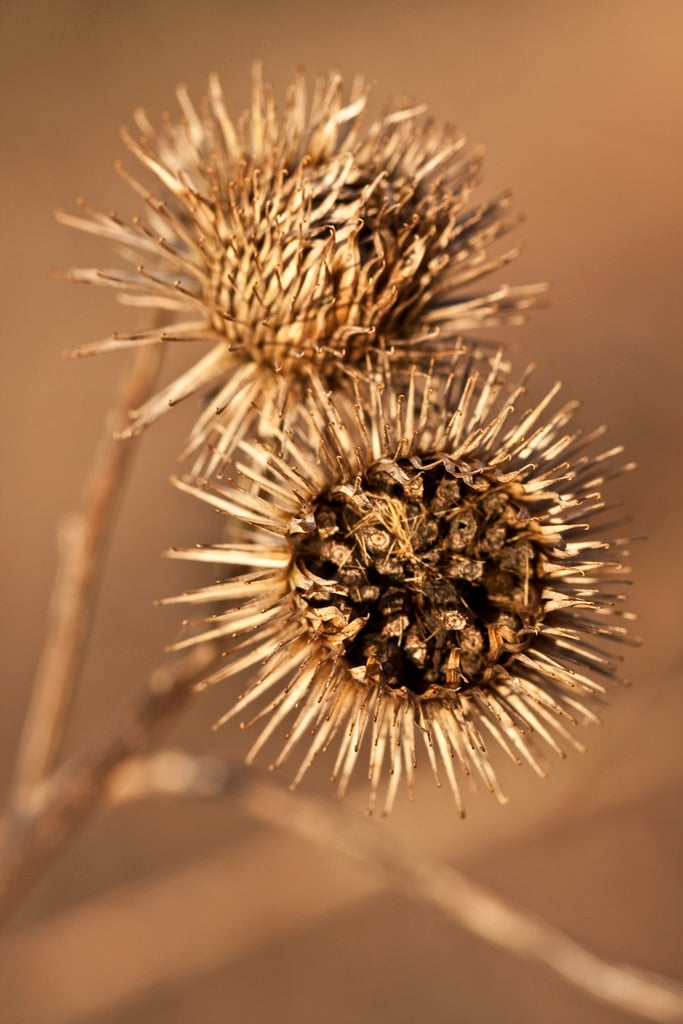
Arctium lappa

RHS Plant Profile
greater burdock
greater burdock RHS

Other common names

beggar's buttons, bur, burdock, burr, clite, clod bur, clot bur, cockle bur, cockle button, cuckle, cuckold, gobo, great bur, great burdock, hardane, hardock, harlock, hurr bur, kiss-me-quick, love leaves, stick-button, cyngaf mawr

Synonyms

Lappa major

Annual Biennial Herbs - Culinary

An erect, branching plant to 2m, with purplish flowerheads in clusters on the leafy main branches, and dull green leaves. Characteristic brown seedheads

Position

Full sun, Partial shade

Soil Types

Clay, Loam, Sand

Max Height

1.5-2.5 metres

Max Spread

1-1.5 metres

Size

Time to Maturity
1–2 years
Max Spread
1-1.5 metres
Max Height
1.5-2.5 metres

Growing Conditions

Clay Loam Sand
Moisture
Moist but well–drained
pH
Acid or Alkaline or Neutral

Position

Full sun Partial shade
Aspect
East–facing or South–facing or West–facing
Exposure
Sheltered
Hardiness
H4

Colour & Scent

Season Stem Flower Foliage Fruit
Spring
Summer
Autumn
Winter

Botanical Details

Family
Asteraceae
Native to GB/Ireland
Yes
Foliage
Deciduous
Habit
Bushy
Genus
Arctium are robust, tap-rooted biennials with large downy leaves and solitary or clustered thistle-like flower-heads turning into burr-like fruiting heads
Name Status
Correct
Plant Range
Eurasia

How to Grow

Cultivation

Ideally grow in moist soil and full sun or partial shade. It will tolerate wide range of soils

Propagation

Propagate by seed; sow in situ in the autumn or early spring. Alternatively, sow in a tray and transplant before the tap-root develops. To improve germination pre- soak or scarify the seed

Suggested planting locations and garden types

  • Wildlife gardens

Pruning

No pruning required

Pests

Generally pest-free

Diseases

Generally disease-free