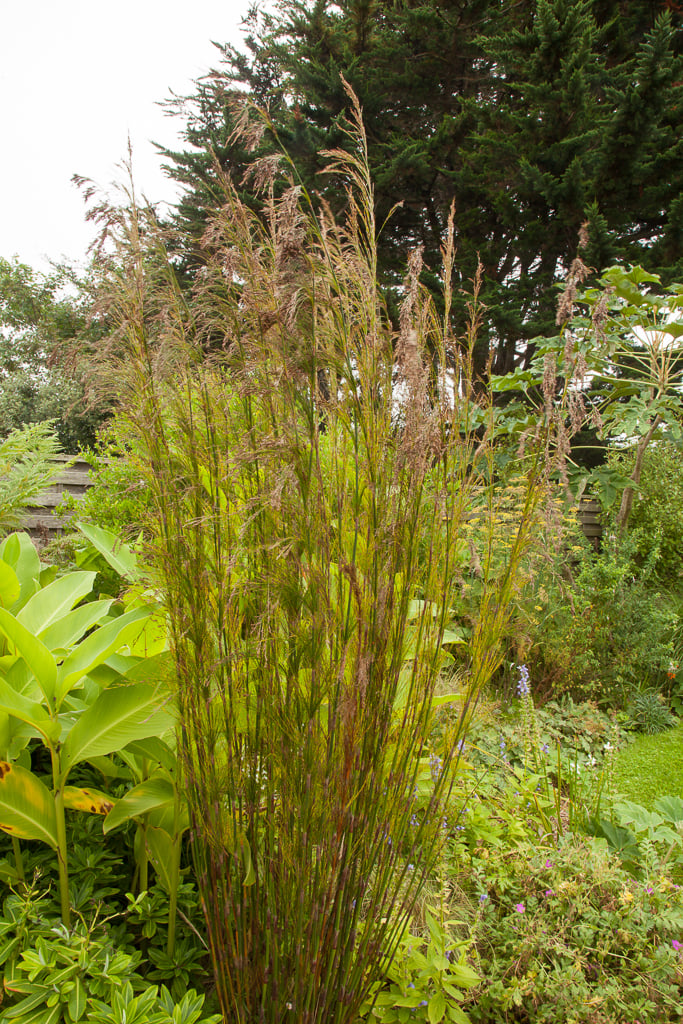
Rhodocoma capensis

RHS Plant Profile
Cape restio
Cape restio John Fielding

Other common names

thatching reed

Award of Garden Merit
Grass Like

A reed-like, rhizomatous perennial with green arching stems up to 2m tall, with distinctive nodes. At each node there is a whirl of finely divided branches which give the plant a feathery appearance. The deep green foliage-like branches are tipped with small brown infloresences in the autumn. The stems are arching when young, but becomer more erect with age.

Position

Full sun, Partial shade

Soil Types

Clay, Loam, Sand

Max Height

1.5-2.5 metres

Max Spread

0.1-0.5 metres

Size

Time to Maturity
2–5 years
Max Spread
0.1-0.5 metres
Max Height
1.5-2.5 metres

Growing Conditions

Clay Loam Sand
Moisture
Moist but well–drained
pH
Acid or Neutral

Position

Full sun Partial shade
Aspect
East–facing or South–facing or West–facing or North–facing
Exposure
Sheltered
Hardiness
H4

Colour & Scent

Season Stem Flower Foliage Fruit
Spring
Summer
Autumn
Winter

Botanical Details

Family
Restionaceae
Native to GB/Ireland
No
Foliage
Evergreen
Habit
Clump forming
Genus
Name Status
Correct
Plant Range
South Africa (Cape)

How to Grow

Cultivation

Grow in moist but well-drained acid to neutral soil in sun or partial shade. Protect plants from ecxessive winter wet by a thick pine bark mulch

Propagation

Propagate by division in early spring but plants should be divided into large clumps as they are slow to recover

Suggested planting locations and garden types

  • Architectural
  • City and courtyard gardens
  • Cottage and informal garden
  • Patio and container plants
  • Flower borders and beds

Pruning

Prune winter damaged stems to the ground

Pests

Generally pest-free

Diseases

Generally disease-free