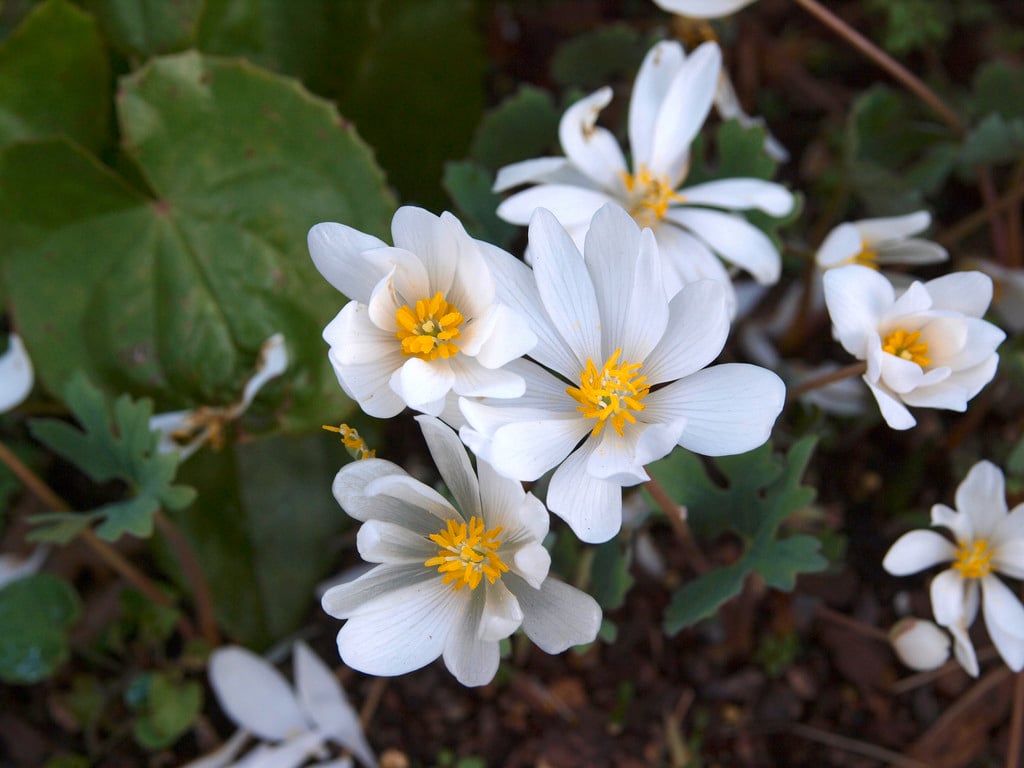
Sanguinaria canadensis

RHS Plant Profile
Canada puccoon
Canada puccoon RHS

Other common names

bloodroot, cornroot, Indian paint, Red Indian paint, red puccoon, snakebite, sweet slumber, bloodwort, tetterwort, turmeric

Herbaceous Perennial

A rhizomatous perennial with fleshy underground stems that exude red sap when cut. As the blue-grey leaves unfurl in spring, it bears white-petalled flowers with yellow anthers. Petals are sometimes pink or grey-flushed on the reverse. Leaves are rounded with scalloped edges

Position

Full sun, Partial shade

Soil Types

Clay, Loam

Max Height

0.1-0.5 metres

Max Spread

0.1-0.5 metres

Size

Time to Maturity
2–5 years
Max Spread
0.1-0.5 metres
Max Height
0.1-0.5 metres

Growing Conditions

Clay Loam
Moisture
Moist but well–drained
pH
Acid or Alkaline or Neutral

Position

Full sun Partial shade
Aspect
East–facing or South–facing or West–facing
Exposure
Sheltered
Hardiness
H5

Colour & Scent

Season Stem Flower Foliage Fruit
Spring
Summer
Autumn
Winter

Botanical Details

Family
Papaveraceae
Native to GB/Ireland
No
Foliage
Deciduous
Habit
Matforming
Genus
Sanguinaria are rhizomatous herbaceous perennials with kidney-shaped, lobed blue-green leaves and cup-shaped white flowers opening with the leaves in spring
Name Status
Correct
Plant Range
E North America

How to Grow

Cultivation

Grow in sun or semi-shade in humus-rich, well-drained soil, such as a woodland garden

Propagation

Propagate by division in autumn or spring or by propagate by seed in autumn; germination can be erratic over the following 2 years

Suggested planting locations and garden types

  • Cottage and informal garden

Pruning

No pruning required

Pests

Generally pest-free

Diseases

Generally disease-free