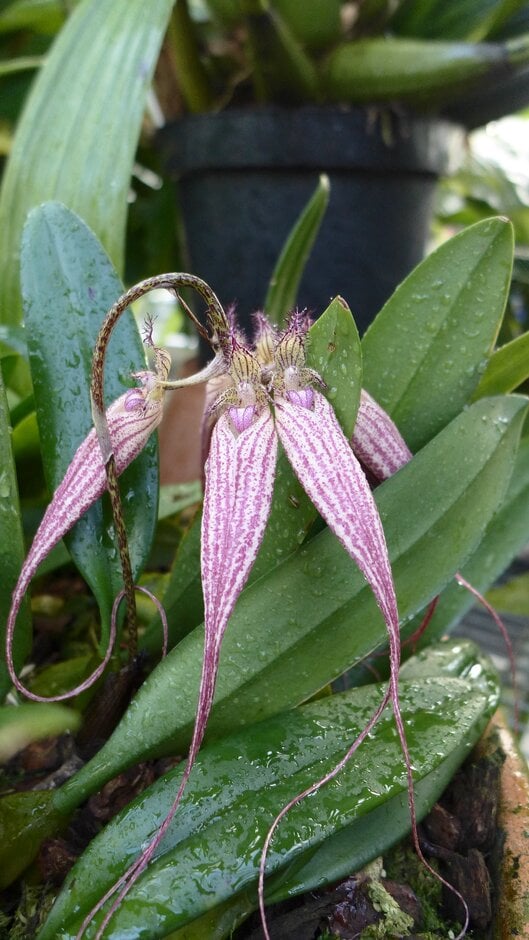
Bulbophyllum Elizabeth Ann gx 'Buckleberry'

RHS Plant Profile
bulbophyllum Elizabeth Ann gx 'Bucklerberry'
bulbophyllum Elizabeth Ann gx 'Bucklerberry' Valeria Valkova

Synonyms

Cirrhopetalum Elizabeth Ann gx 'Bucklebury'

Conservatory Greenhouse

A warm to hot growing epiphytic orchid which is a hybrid of Bulbophyllum longissimum and Bulbophyllum rothschildianum. The plant produces short, angled, egg-shaped green stems called pseudobulbs, which are adapted to store water and nutrients. The pseudobulbs arise from a creeping, rooting stem, and each are topped with a single, green, oblong to lance-shaped, leaf. Flowers are produced from autumn to spring, in clusters at the end of thin stems and are pale pink with darker pink fine stripes. The upper sepal is somewhat hairy, and pale green with darker stripes, while the lower sepals are up to 30cm long. The hinged lip, an adapted petal evolved to attract pollinators, moves in the slightest breeze, is tongue-shaped and pink. The flowers are scented and appear from autumn to spring

Position

Partial shade

Max Height

0.1-0.5 metres

Max Spread

0.1-0.5 metres

Size

Time to Maturity
2–5 years
Max Spread
0.1-0.5 metres
Max Height
0.1-0.5 metres

Growing Conditions

Moisture
Moist but well–drained
pH
Neutral

Position

Partial shade
Aspect
East–facing or North–facing or West–facing
Exposure
Sheltered
Hardiness
H1A

Colour & Scent

Fragrance Flower
Season Stem Flower Foliage Fruit
Spring
Summer
Autumn
Winter

Botanical Details

Family
Orchidaceae
Native to GB/Ireland
No
Foliage
Evergreen
Habit
Clump forming, Spreading branched
Genus
A large, diverse genus of mainly epiphytic, sympodial tropical orchids, producing a clump of small pseudobulbs, which serve as plant’s storage for water and nutrients. Most species carry one leaf on top of each pseudobulb. Over 2000 species have been described and accepted
Name Status
Accepted

How to Grow

Cultivation

Grow in an open, well drained but moisture-retentive mix of medium orchid bark, sphagnum moss and perlite. Shallow, wide pots or baskets are best used to accommodate its spreading habit. Bright filtered light is best as direct sunlight through glass can scorch its leaves. Prefers a minimum night temperature of 15°C and a maximum of 30°C in the daytime. Nighttime temperatures should be 10°C lower than daytime temperatures for good growth and is beneficial to induce flowering. High humidity is required along with gentle air movement. Allow plants to freely drain when watering and avoid plants sitting in water as this can cause roots to rot. Plants may be intolerant of hard tap water, so irrigate with rainwater at room temperature. Orchid fertiliser can be applied regularly throughout the growing season, March to September. Reduce watering and feeding in winter months

Propagation

Propagation by seed will not produce plants true to type as this is a hybrid cultivar. Mature plants may be divided when the plant overgrows its container. Each division should have at least 3 older pseudobulbs with a sufficient amount of stored energy and water, to support new growth and reduce stress after repotting

Suggested planting locations and garden types

  • Conservatory and greenhouse
  • Cut flowers

Pruning

No pruning required apart from the removal of faded flowers

Pests

May be susceptible to mealybugs and scale insects infestations

Diseases

Generally disease free