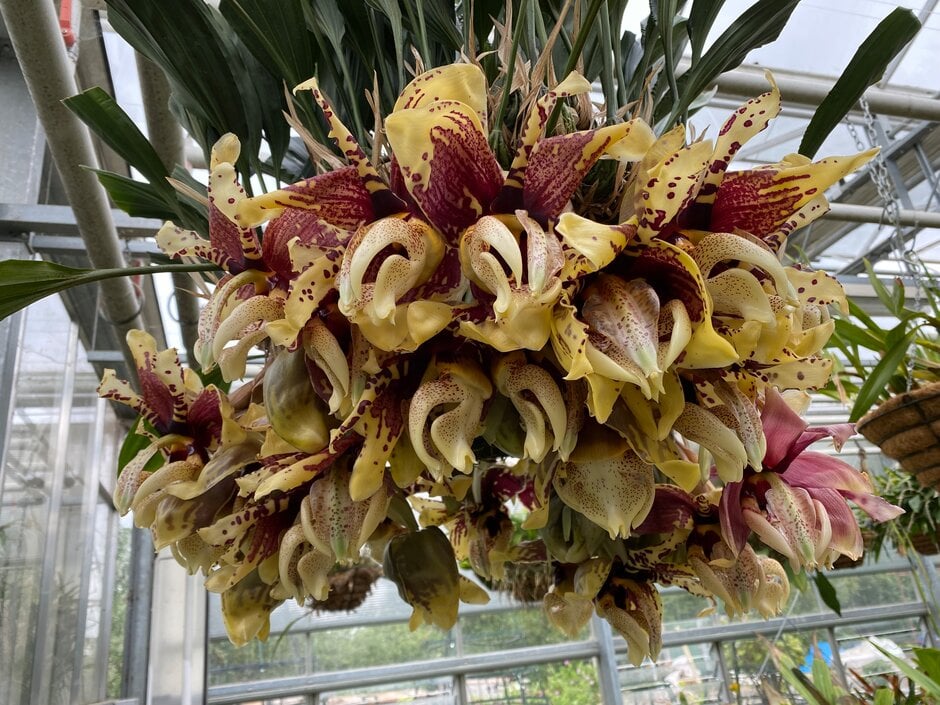
Stanhopea tigrina

RHS Plant Profile
tiger-like standhopea
tiger-like standhopea Valeria Valkova
Conservatory Greenhouse

A medium to large-sized epiphytic orchid with broadly elliptic, dark green, leathery leaves. The plant produces a large clump of ovoid, ribbed pseudobulbs (thickened stem at the base of each growth), which serve as a storage organ for water and nutrients. Each pseudobulb carries one 40cm long and 10cm wide leaf. Pendant flower stems emerge from basket base in summer and autumn and carry 2-8 large, fleshy yellow flowers with dark red markings. Each sweetly scented flower is up to 20cm large. The flowers are short-lived, lasting only 2-4 days, but large plants produce numerous racemes that flower in succession. This orchid has evolved in a unique way - to mimic and deceive its pollinator. Downwards facing, complex flowers are pollinated by male Eugossine bees (also called Orchid Bees) that confuse the flowers for females.

Position

Partial shade

Max Height

0.1-0.5 metres

Max Spread

0.5-1 metres

Size

Time to Maturity
5–10 years
Max Spread
0.5-1 metres
Max Height
0.1-0.5 metres

Growing Conditions

Moisture
Moist but well–drained or Well–drained
pH
Neutral

Position

Partial shade
Aspect
East–facing or North–facing or South–facing or West–facing
Exposure
Sheltered
Hardiness
H1A

Colour & Scent

Fragrance Flower
Season Stem Flower Foliage Fruit
Spring
Summer
Autumn
Winter

Botanical Details

Family
Orchidaceae
Native to GB/Ireland
No
Foliage
Evergreen
Habit
Clump forming
Genus
A genus of the orchid family from Central and South America. This genus of epiphytic orchids is characteristic for its complex flowers. Flowers grow downwards and are strongly fragrant, but fairy short-lived. Ribbed, ovoid pseudobulbs form a tight clump, with each carrying one large, stemmed leaf
Name Status
Correct
Plant Range
Mexico

How to Grow

Cultivation

Grow in a hanging basket lined with moss, in an open, bark-based orchid compost with addition of perlite and sphagnum moss. Provide enough bright filtered light, but keep away from direct sunlight or a heating source. May be grown in intermediate to warm conditions with temperatures between 12-30 °C. Seasonal and daily fluctuation of temperatures encourage flowering. Average humidity of 50-70% is sufficient and watering should be frequent enough during growing season (approximately once per week), with being reduced by half during winter months. Large specimens produce best flowering, however it is desirable to repot plants every few years to avoid stale, disintegrated potting mix.

Propagation

Propagation by seed is only possible in a controlled laboratory environment. Mature plants may be divided when the plant overgrows its container. Each division should have at least 3 older pseudobulbs with a sufficient amount of stored energy and water, to support new growth and reduce stress after repotting.

Suggested planting locations and garden types

  • Houseplants
  • Conservatory and greenhouse

Pruning

No pruning required. Remove spent flowers after flowering.

Pests

May be susceptible to scale insects or mealybugs but generally pest-free

Diseases

May be susceptible to bacterial spots on the leaves caused by insufficient ventilation combined with overhead watering but generally disease-free