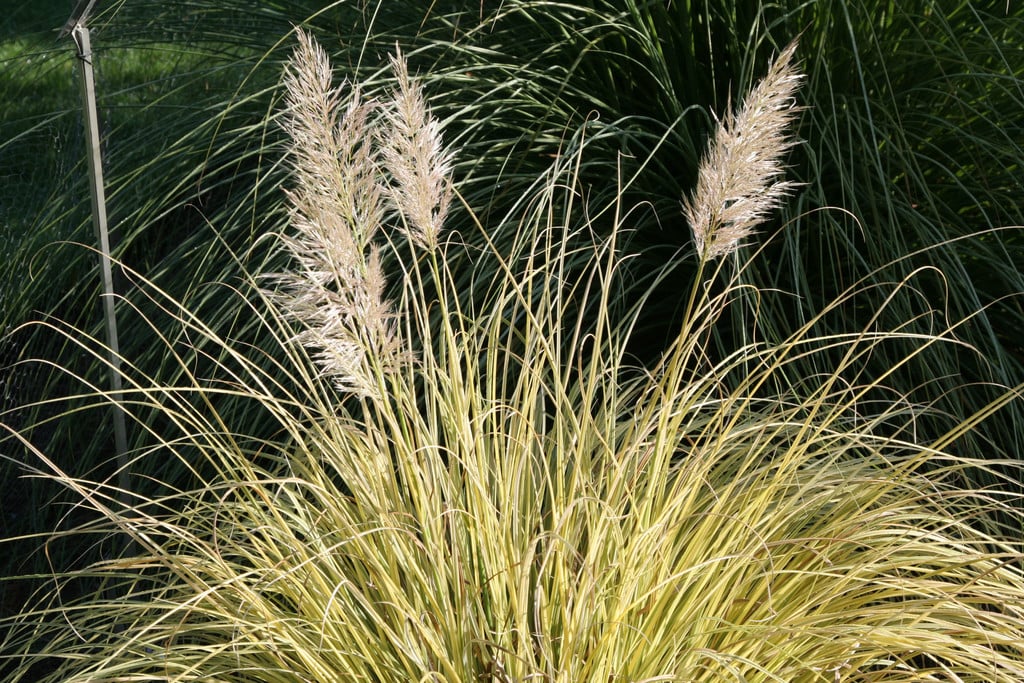
Cortaderia selloana 'Splendid Star'PBR (v)

RHS Plant Profile
pampas grass 'Splendid Star'
pampas grass 'Splendid Star' RHS

Synonyms

Cortaderia 'Splendid Star'

Grass Like

'Splendid Star' is a densely tufted, clump-forming, perennial grass, 1.2m high and 1.2m wide, with evergreen, arching, sharply toothed, blue-green leaves striped with yellow, and plume-like panicles of glistening silver-white spikelets, in late summer

Position

Full sun

Soil Types

Chalk, Clay, Loam, Sand

Max Height

1-1.5 metres

Max Spread

1-1.5 metres

Size

Time to Maturity
2–5 years
Max Spread
1-1.5 metres
Max Height
1-1.5 metres

Growing Conditions

Chalk Clay Loam Sand
Moisture
Moist but well–drained or Well–drained
pH
Acid or Alkaline or Neutral

Position

Full sun
Aspect
North–facing or South–facing or West–facing or East–facing
Exposure
Exposed or Sheltered
Hardiness
H6
Drought Resistance
Yes

Colour & Scent

Season Stem Flower Foliage Fruit
Spring
Summer
Autumn
Winter

Botanical Details

Family
Poaceae
Native to GB/Ireland
No
Foliage
Evergreen
Habit
Tufted
Genus
Cortaderia are robust evergreen grasses forming large, compact tufts of narrowly linear, rough-edged leaves, with erect stems bearing dense silvery or pink-tinged flower panicles which are excellent for drying
Name Status
Accepted

How to Grow

Cultivation

Grow in fertile, deep, well-drained soil in full sun, and cover with a deep dry mulch to protect plants from frost in their first winter; choose planting positions carefully, because they need plenty of space, because of the sharp leaf edges, and because seedlings can be invasive; for more advice, see ornamental grasses cultivation

Propagation

Propagate by division in late spring; propagation for resale is prohibited without a licence

Suggested planting locations and garden types

  • Gravel garden
  • Prairie planting
  • Architectural
  • City and courtyard gardens
  • Coastal
  • Cottage and informal garden
  • Flower borders and beds
  • Cut flowers

Pruning

Cut and comb out the last year's flower stems and dead leaves in late winter or early spring; wear gloves as protection from the sharp leaf edges

Pests

Generally pest-free

Diseases

Generally disease-free