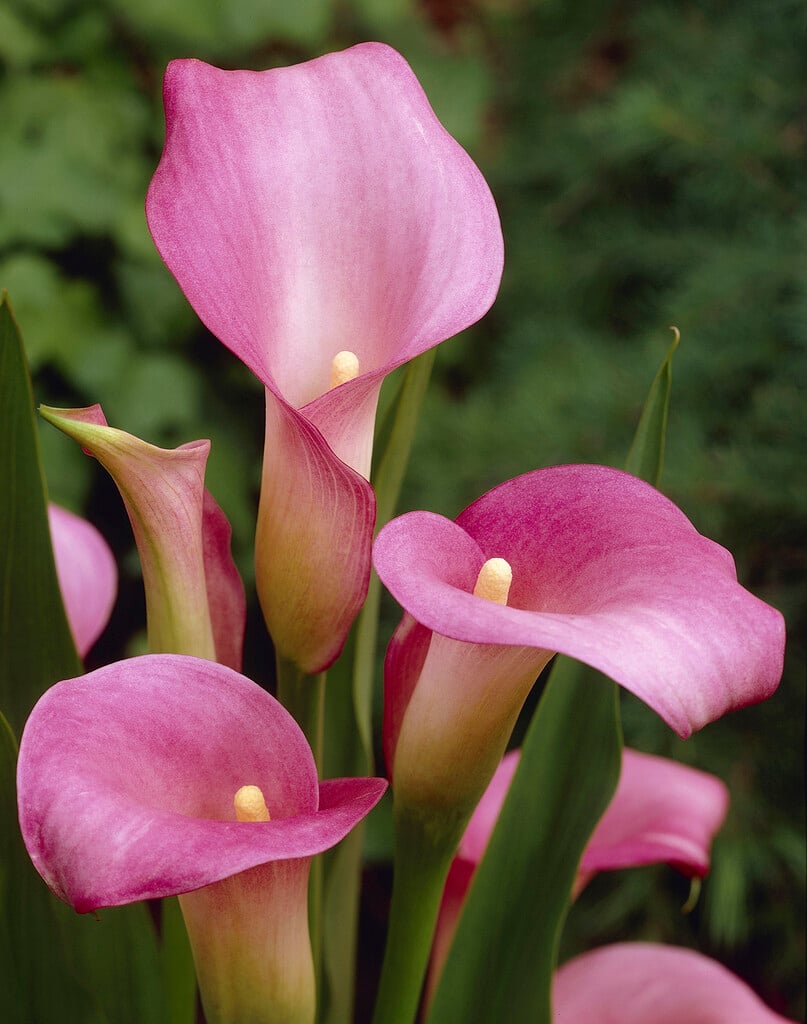
Zantedeschia rehmannii

RHS Plant Profile
pink calla

Other common names

pink arum, red calla

Conservatory Greenhouse Houseplants

A tender, rhizomatous perennial to 40cm tall, forming a clump of dark green, lance-shaped leaves. In summer it freely produces exotic-looking flowers, composed of a funnel-shaped pink spathe to 12cm long around a yellow spadix

Position

Full sun

Soil Types

Loam, Sand

Max Height

0.1-0.5 metres

Max Spread

0.1-0.5 metres

Size

Time to Maturity
2–5 years
Max Spread
0.1-0.5 metres
Max Height
0.1-0.5 metres

Growing Conditions

Loam Sand
Moisture
Moist but well–drained
pH
Acid or Alkaline or Neutral

Position

Full sun
Aspect
South–facing or West–facing
Exposure
Sheltered
Hardiness
H1C

Colour & Scent

Season Stem Flower Foliage Fruit
Spring
Summer
Autumn
Winter

Botanical Details

Family
Araceae
Native to GB/Ireland
No
Foliage
Deciduous
Habit
Clump forming
Potentially harmful
Harmful if eatenskin/eye irritant. Wear gloves and other protective equipment when handling. Pets: Harmful if eatenskin/eye irritant - for further information and contact numbers regarding pets, see the HTA guide to potentially harmful plants
Genus
Zantedeschia can be deciduous or semi-evergreen, tuberous perennials with lance-shaped or arrow-shaped leaves and tiny yellow flowers forming a dense spike-like spadix, with a showy, hood-like spathe, sometimes followed by orange berry-like fruits
Name Status
Correct
Plant Range
South Africa, Swaz.

How to Grow

Cultivation

Grow in peat-free, loam-based potting compost in full light. When in growth, water freely and apply a balanced liquid fertiliser every 2-3 weeks. Calla lilies need a period of dormancy over winter, with little or no water. Once the leaves die down after flowering, move them to a dry, frost-free, preferably dark location until spring. See Zantedeschia cultivation

Propagation

Propagate by seed or division

Suggested planting locations and garden types

  • Houseplants
  • Patio and container plants
  • Bedding
  • Conservatory and greenhouse

Pruning

Remove the flowers as they start to fade, pulling the entire stem out at the base

Pests

May be susceptible to glasshouse red spider mite

Diseases

Generally disease-free