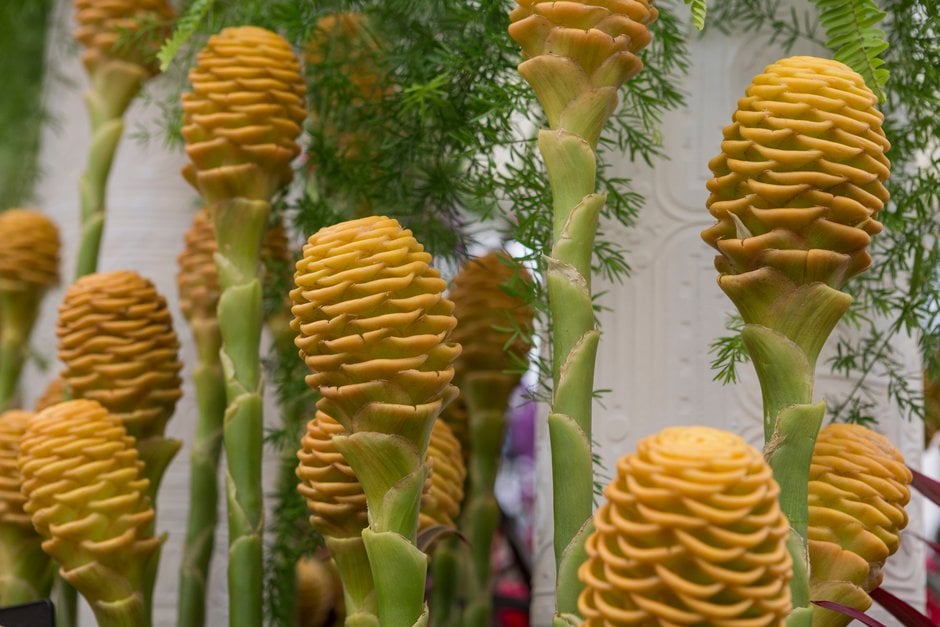
Zingiber spectabile

RHS Plant Profile
beehive ginger
beehive ginger RHS
Herbaceous Perennial Conservatory Greenhouse

a rhizomatous perennial with erect, unbranched stems up to 2.5m tall arising from the fleshy rhizomes bearing narrow, lance-shaped leaves. Small, purple and white flowers with yellow spots are borne on stems up to 50cm tall and emerge from pale yellow-orange bracts that overlap to form a cylindrical, beehive-like structure; the bracts may darken with age to orange and red

Position

Full sun, Partial shade

Soil Types

Clay, Loam, Sand

Max Height

2.5-4 metres

Max Spread

0.5-1 metres

Size

Time to Maturity
2–5 years
Max Spread
0.5-1 metres
Max Height
2.5-4 metres

Growing Conditions

Clay Loam Sand
Moisture
Moist but well–drained
pH
Acid or Alkaline or Neutral

Position

Full sun Partial shade
Aspect
South–facing or West–facing or East–facing
Exposure
Sheltered
Hardiness
H1A

Colour & Scent

Season Stem Flower Foliage Fruit
Spring
Summer
Autumn
Winter

Botanical Details

Family
Zingiberaceae
Native to GB/Ireland
No
Foliage
Deciduous
Habit
Columnar upright
Genus
Zingiber are aromatic rhizomatous perennials with alternate, oblong leaves in two ranks, and cone-like inflorescences with overlapping, sometimes brightly coloured bracts, and 3-petalled flowers
Name Status
Correct
Plant Range
Malaysia

How to Grow

Cultivation

Grow in rich, well-drained, moisture-retentive soil in filtered sunlight and high humidity, either directly in the border of a heated greenhouse, or in a container indoors

Propagation

Propagate by seed or by division of well-established plants in early spring, or by separating and replanting sections of rhizome 15-20cm long in spring or early summer

Suggested planting locations and garden types

  • Architectural
  • Patio and container plants
  • Cut flowers

Pruning

Cut back old stems as they die back in the autumn

Pests

May be susceptible to glasshouse red spider mite under glass

Diseases

Generally disease-free