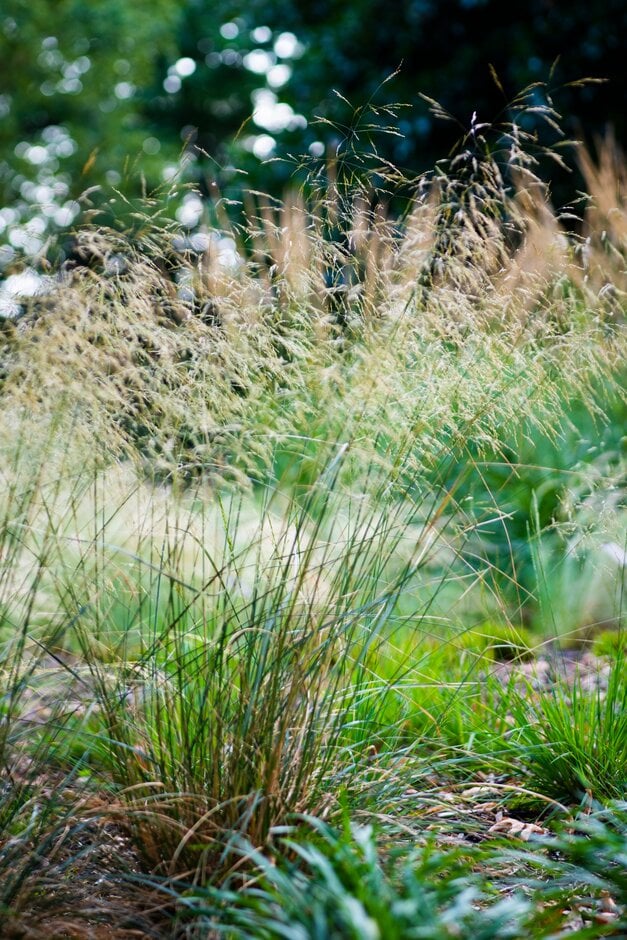
Deschampsia cespitosa 'Schottland'
A clump-forming grass to around 1m tall forming neat tussocks of erect to arching, dark green narrow leaves. Upright stems held above the foliage in summer bear airy panicles of bronzy-brown flowers that form golden seedheads by autumn

Buy this plant
Size
Ultimate height
0.5–1 metresTime to ultimate height
2–5 yearsUltimate spread
0.5–1 metresGrowing conditions
Moisture
Moist but well–drained, Well–drainedpH
Acid, NeutralColour & scent
| Stem | Flower | Foliage | Fruit | |
| Spring | Green | |||
|---|---|---|---|---|
| Summer | Bronze Brown | Green | ||
| Autumn | Gold | Green | ||
| Winter | Green |
Position
- Full sun
- Partial shade
Aspect
East–facing or South–facing or West–facing or North–facing
Exposure
Exposed or Sheltered Hardiness
H6Botanical details
- Family
- Poaceae
- Native to GB / Ireland
- No
- Foliage
- Evergreen
- Habit
- Clump forming
- Genus
Deschampsia can be deciduous or evergreen, tufted grasses with linear or thread-like leaves and open flowering panicles in summer
- Name status
Accepted
How to grow
Cultivation
Grows well in well-drained to moist but well-drained, humus-rich soils in partial shade or full sun if the soil is not prone to drying out. See also ornamental grasses cultivation
Propagation
Propagate by division in early summer
Suggested planting locations and garden types
- Cottage and informal garden
- Prairie planting
- Wildflower meadow
- Flower borders and beds
Pruning
Cut back old stems to the ground in early spring before growth resumes
Pests
Generally pest-free
Diseases
May be susceptible to a rust
Get involved
The Royal Horticultural Society is the UK’s leading gardening charity. We aim to enrich everyone’s life through plants, and make the UK a greener and more beautiful place.