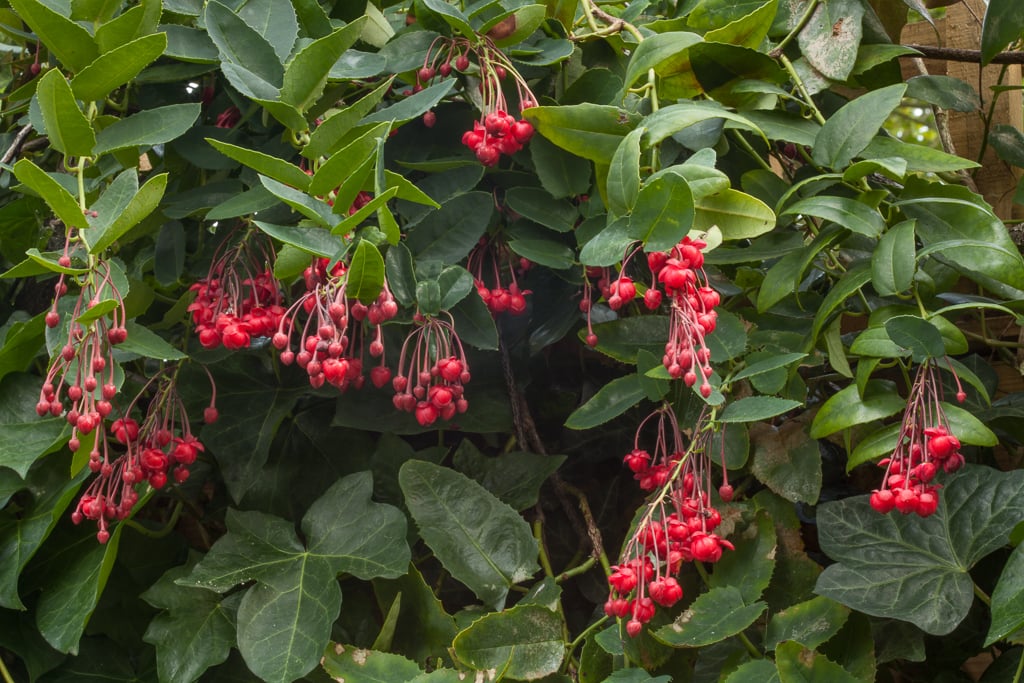
Berberidopsis corallina

RHS Plant Profile
coral plant
coral plant John Fielding

Other common names

coral barberry, coralberry

Climber Wall Shrub

A twining woody climber with dark green, slightly spiny, evergreen foliage and hanging clusters of rounded deep red flowers from summer through to autumn

Position

Full shade, Partial shade

Soil Types

Loam, Sand

Max Height

4-8 metres

Max Spread

0.5-1 metres

Size

Time to Maturity
2–5 years
Max Spread
0.5-1 metres
Max Height
4-8 metres

Growing Conditions

Loam Sand
Moisture
Well–drained
pH
Acid

Position

Full shade Partial shade
Aspect
North–facing or West–facing
Exposure
Sheltered
Hardiness
H4

Colour & Scent

Season Stem Flower Foliage Fruit
Spring
Summer
Autumn
Winter

Botanical Details

Family
Berberidopsidaceae
Native to GB/Ireland
No
Foliage
Evergreen
Habit
Climbing
Genus
Berberidopsis is a scrambling or weakly twining evergreen shrub with sharply toothed ovate leaves and axillary clusters or short terminal racemes of bowl-shaped deep red flowers in summer and early autumn
Name Status
Correct
Plant Range
Central and Southern Chile

How to Grow

Cultivation

A choice plant for a sheltered north wall in a sandy, fertile acidic soil. Although it is considered mainly hardy, Berberidopsis dislikes cold winds and can be caught by winter frosts

Propagation

Propagate by softwood cuttings, seed or layering

Suggested planting locations and garden types

  • City and courtyard gardens
  • Cottage and informal garden
  • Conservatory and greenhouse

Pruning

No pruning required but, If necessary, prune in spring after threat of frost has passed. Remove weak or dead stems from base. Does not regenerate well if pruned hard

Pests

Generally pest-free

Diseases

Generally disease-free