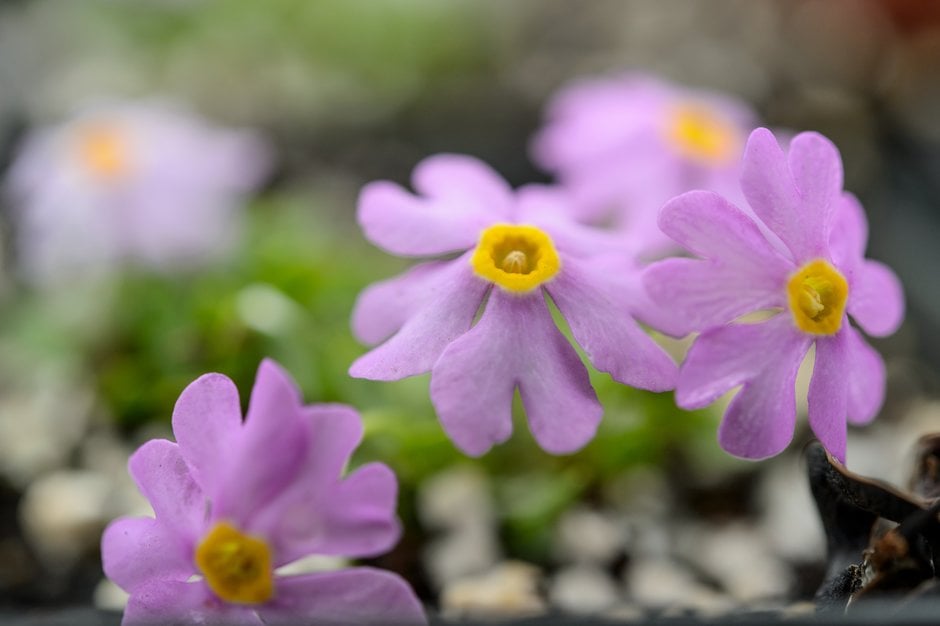
Primula fasciculata (Ar)

<em>Primula</em> <em>fasciculata</em> (Ar) RHS
Alpine Rockery

A very small, rosette- to mat-forming perennial with shiny, fleshy, bright green oblong leaves. Yellow-eyed, light to dark pink or, rarely, white flowers are produced in spring

Position

Partial shade

Soil Types

Loam

Max Height

Up to 10 cm

Max Spread

0.1-0.5 metres

Size

Time to Maturity
2–5 years
Max Spread
0.1-0.5 metres
Max Height
Up to 10 cm

Growing Conditions

Loam
Moisture
Moist but well–drained or Poorly–drained
pH
Acid or Neutral

Position

Partial shade
Aspect
North–facing or West–facing or East–facing
Exposure
Exposed
Hardiness
H7

Colour & Scent

Season Stem Flower Foliage Fruit
Spring
Summer
Autumn
Winter

Botanical Details

Family
Primulaceae
Native to GB/Ireland
No
Foliage
Deciduous
Habit
Matforming
Genus
Primula are herbaceous or semi-evergreen perennials, forming a basal rosette of simple leaves, with salver-shaped or bell-shaped flowers which may be solitary or carried in an umbel or in whorls on an erect stem
Name Status
Correct
Horticultural Group
Primula armerina have smooth, hairless, spoon-shaped foliage that do not have the powdery coating ('farina') that some species have
Plant Range
China

How to Grow

Cultivation

Grow in partial shade in permanently moist, humus-rich, acid to neutral soil. Suitable for an alpine trough, but tends to be short-lived

Propagation

Propagate by seed or by division

Suggested planting locations and garden types

  • Patio and container plants
  • Rock garden

Pruning

No pruning required

Pests

May be susceptible to aphids, leafhoppers and slugs

Diseases

May be susceptible to a virus, primula brown core or grey moulds