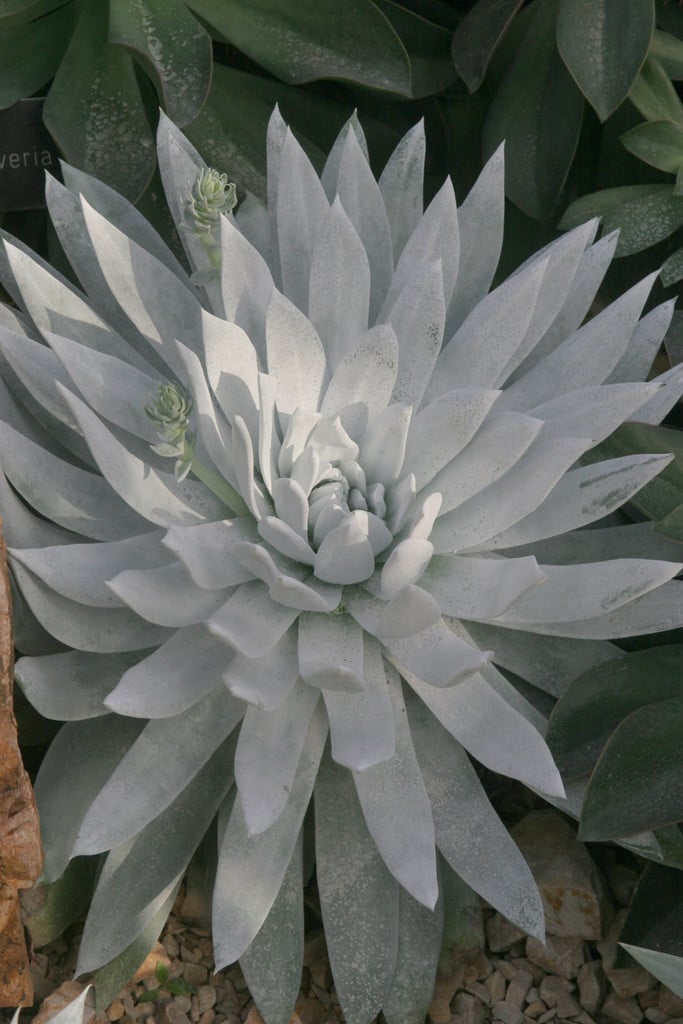
Dudleya brittonii

RHS Plant Profile
Britton's dudleya
Britton's dudleya RHS

Other common names

giant chalk dudleya

Cactus Succulent

A variable, perennial succulent forming a white to silver-grey solitary rosette to 30-45cm (12-18in) in diameter, with oblong to lanceolate, spoon-shaped leaves to 15-22.5cm (6-9in) long and 2.5-5cm (1-2in) wide. Pale yellow flowers are produced on a bright, reddish-pink stem, to 60- 90cm (24-36in) in late winter to spring

Position

Full sun

Soil Types

Loam, Sand

Max Height

0.1-0.5 metres

Max Spread

0.1-0.5 metres

Size

Time to Maturity
5–10 years
Max Spread
0.1-0.5 metres
Max Height
0.1-0.5 metres

Growing Conditions

Loam Sand
Moisture
Well–drained
pH
Acid or Alkaline or Neutral

Position

Full sun
Aspect
South–facing or West–facing
Exposure
Sheltered
Hardiness
H3
Drought Resistance
Yes

Colour & Scent

Season Stem Flower Foliage Fruit
Spring
Summer
Autumn
Winter

Botanical Details

Family
Crassulaceae
Native to GB/Ireland
No
Foliage
Evergreen
Habit
Bushy
Genus
Dudleya are a genus of around 45 species of succulent perennial plants. Formerly classified as Echeveria, they have green to grey fleshy leaves arranged in rosettes. Flowers appear on tall stems, up to a metre above the leaves.
Name Status
Correct
Plant Range
Baja California

How to Grow

Cultivation

Under glass, grow in sharply-draining, peat-free, loam-based compost with the addition of extra sharp sand, or use proprietary peat-free cactus compost. A position in full or slightly filtered light is preferred at all times. During active growth, water moderately and apply a low-nitrogen fertiliser once a month from March to the beginning of May and from late August to October, but cease feeding in the summer dormancy period, when water should be withheld. Feeding in the winter in UK under glass is not required owing to low daylight levels and similarly, watering should also be reduced

Propagation

Propagate by seed at 16°C (61°F) in early spring or take stem cuttings from spring to summer

Suggested planting locations and garden types

  • Patio and container plants
  • Sub-tropical

Pruning

No pruning required

Pests

May be susceptible to mealybugs under glass

Diseases

Generally disease-free, although may be susceptible to basal rots if watered out of season when dormant