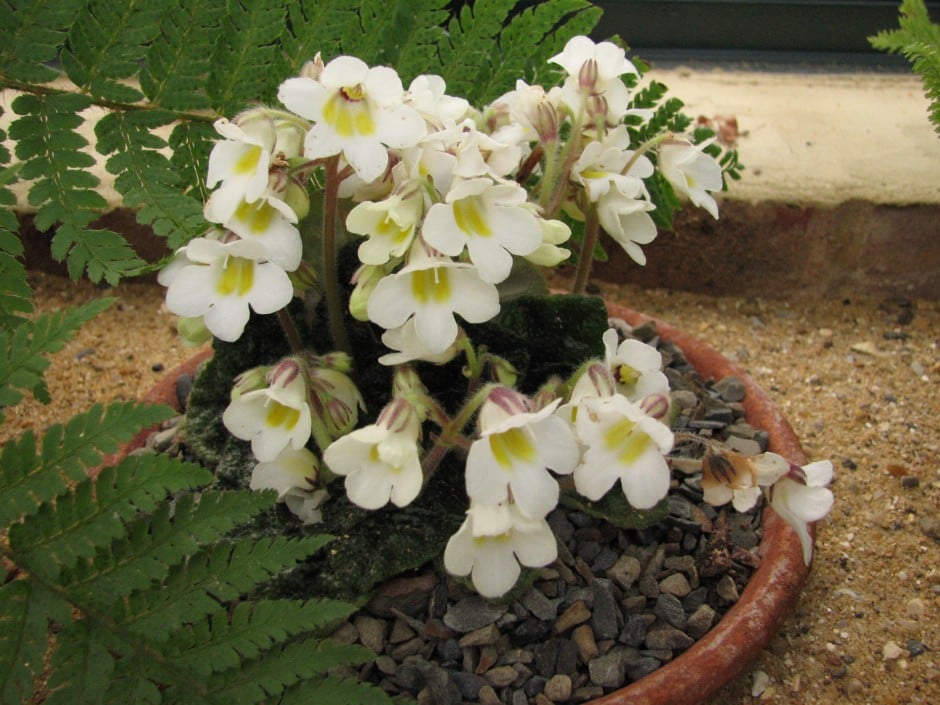
Petrocosmea begoniifolia C.Y. Wu ex H.W. Li

RHS Plant Profile
begonia-leaved petrocosmea
begonia-leaved petrocosmea RHS
Alpine Rockery

An alpine herbaceous perennial up to 10cm high, with an almost flat rosette of glossy, succulent dark green leaves with a dimpled texture, and dark red stems carrying white flowers with yellow throats in spring

Position

Partial shade

Soil Types

Chalk, Loam, Sand

Max Height

Up to 10 cm

Max Spread

0.1-0.5 metres

Size

Time to Maturity
2–5 years
Max Spread
0.1-0.5 metres
Max Height
Up to 10 cm

Growing Conditions

Chalk Loam Sand
Moisture
Well–drained
pH
Acid or Alkaline or Neutral

Position

Partial shade
Aspect
North–facing or West–facing or East–facing
Exposure
Sheltered
Hardiness
H2

Colour & Scent

Season Stem Flower Foliage Fruit
Spring
Summer
Autumn
Winter

Botanical Details

Family
Gesneriaceae
Native to GB/Ireland
No
Foliage
Evergreen
Habit
Matforming
Genus
Petrocosmea are evergreen perennials producing low rosettes of fleshy, often felted, lance-shaped or rounded leaves. Five-lobed, tubular to bell-shaped flowers are produced in small clusters in spring
Name Status
Correct
Plant Range
Yunnan

How to Grow

Cultivation

Grow in a cold greenhouse or alpine house, in indirect light, in a shallow pot of very well-drained, peat-free, loam-based compost with added grit and leafmould; water moderately while growing, and sparingly in winter, and always keep water off the leaves; in frost-free climates, grow in shade in vertical crevices in walls or rock gardens so that rain will drain away

Propagation

Propagate by seed sown as soon as it is ripe, or by leaf cuttings in summer and autumn

Suggested planting locations and garden types

  • Patio and container plants

Pruning

No pruning required

Pests

May be susceptible to slugs, snails, aphids, glasshouse whitefly, mealybugs, scale insects and tarsonemid mites

Diseases

May be susceptible to downy mildews and by crown, leaf, stem and root rots