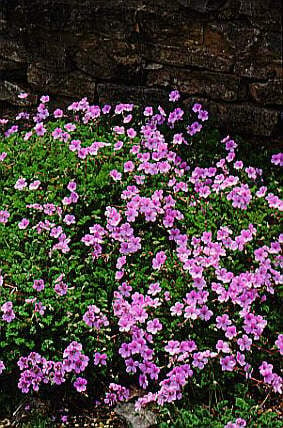
Erodium glandulosum

RHS Plant Profile
black-eyed heron's bill
black-eyed heron's bill Dorling Kindersley 2003

Other common names

blue-eyed heron's bill

Synonyms

Erodium petraeum subsp. glandulosum
Erodium macradenum

Award of Garden Merit
Herbaceous Perennial

A compact herbaceous perennial to 20cm, forming a clump of small, grey-green, oval leaves. Flowers 2.5cm in width, lilac-pink with darker veins

Position

Full sun

Soil Types

Chalk, Loam

Max Height

0.1-0.5 metres

Max Spread

0.1-0.5 metres

Size

Time to Maturity
2–5 years
Max Spread
0.1-0.5 metres
Max Height
0.1-0.5 metres

Growing Conditions

Chalk Loam
Moisture
Well–drained
pH
Alkaline or Neutral

Position

Full sun
Aspect
East–facing or South–facing or West–facing
Exposure
Exposed
Hardiness
H5

Colour & Scent

Fragrance Foliage
Season Stem Flower Foliage Fruit
Spring
Summer
Autumn
Winter

Botanical Details

Family
Geraniaceae
Native to GB/Ireland
No
Foliage
Deciduous
Habit
Clump forming
Genus
Erodium can be annuals, perennials or subshrubs, some evergreen, with lobed or pinnately divided leaves and bowl-shaped, 5-petalled flowers in summer
Name Status
Correct

How to Grow

Cultivation

Grow in gritty, humus-rich, well-drained soil that is neutral to alkaline; needs full sun

Propagation

Propagate by seed in pots in an open frame as soon as seed is ripe. Propagate by division in spring. Propagate by basal stem cuttings in late spring to early summer.

Suggested planting locations and garden types

  • Rock garden
  • Gravel garden
  • Patio and container plants
  • Garden edging

Pruning

No pruning required

Pests

Generally pest-free

Diseases

Generally disease-free