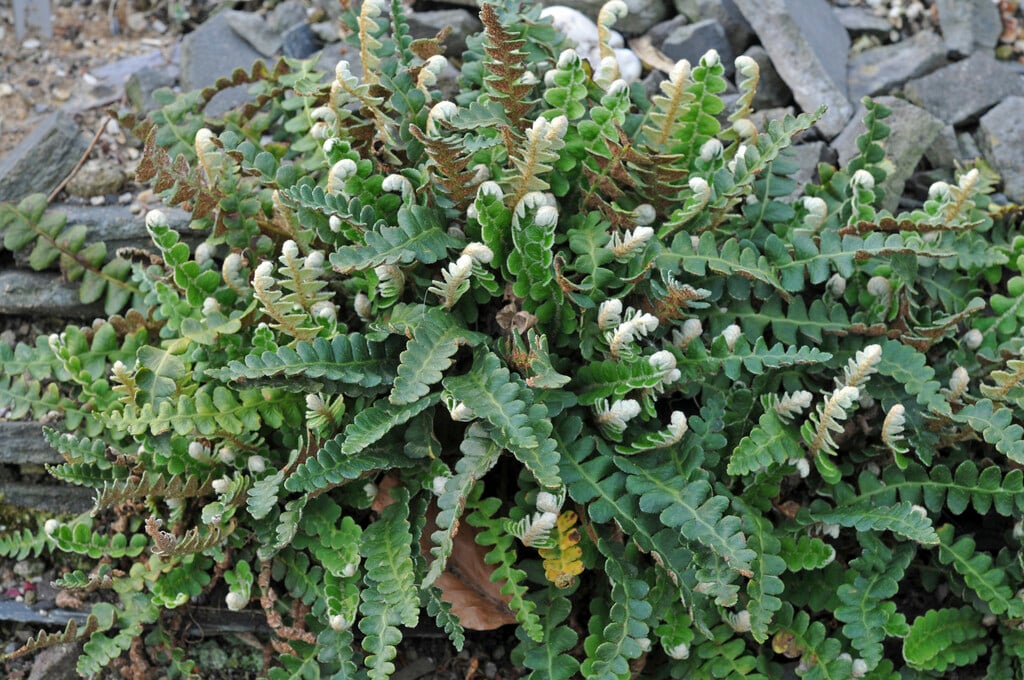
Asplenium ceterach

RHS Plant Profile
rustyback fern
rustyback fern visionspictures.com

Other common names

finger fern, fringe fern, milt waste, scale fern, scaly spleenwort, stone fern

Synonyms

Ceterach vulgare
Ceterach officinarum
Asplenium officinarum

Ferns Herbaceous Perennial

A terrestrial, evergreen fern about 15cm tall, with short, upright rhizomes and tufts of narrow, lance-shaped fronds to 20cm long, dark green above with rusty brown scales beneath

Position

Partial shade

Soil Types

Loam, Sand, Chalk

Max Height

0.1-0.5 metres

Max Spread

0.1-0.5 metres

Size

Time to Maturity
2–5 years
Max Spread
0.1-0.5 metres
Max Height
0.1-0.5 metres

Growing Conditions

Loam Sand Chalk
Moisture
Moist but well–drained
pH
Alkaline or Neutral

Position

Partial shade
Aspect
East–facing or North–facing or West–facing
Exposure
Sheltered
Hardiness
H5

Colour & Scent

Season Stem Flower Foliage Fruit
Spring
Summer
Autumn
Winter

Botanical Details

Family
Aspleniaceae
Native to GB/Ireland
Yes
Foliage
Evergreen
Habit
Clump forming, Tufted
Genus
Asplenium are evergreen ferns with short, usually erect rhizomes bearing a rosette of slightly leathery fronds which may be simple, pinnate to 3-pinnate
Name Status
Correct
Plant Range
Europe, N Africa, W Asia

How to Grow

Cultivation

Grow in humus-rich, moist but well-drained, preferably alkaline soil with added grit, in partial shade. See how to grow ferns for further advice

Propagation

Propagate by division, or propagate by sowing spores as soon as ripe at 15°C

Suggested planting locations and garden types

  • City and courtyard gardens
  • Cottage and informal garden
  • Patio and container plants
  • Rock garden
  • Flower borders and beds
  • Underplanting of roses and shrubs
  • Wall side borders

Pruning

Dead or damaged fronds may be removed as necessary

Pests

Generally pest-free

Diseases

Generally disease-free