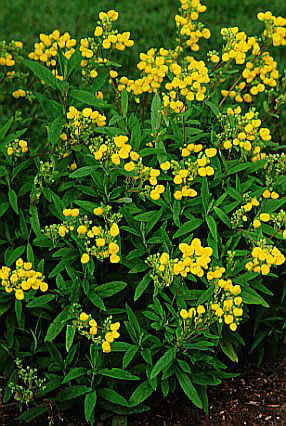
Calceolaria integrifolia

RHS Plant Profile
slipperwort
slipperwort Dorling Kindersley 2003

Synonyms

Calceolaria rugosa
Calceolaria stewartii hort.

Award of Garden Merit
Bedding Herbaceous Perennial

A small, bushy, upright evergreen sub-shrub. Leaves 5-8cm in length, ovate or oblong, dull green and veiny above, hairy beneath. Flowers 12mm width, bright yellow, in large corymbs to 12cm in width

Position

Full sun, Partial shade

Soil Types

Clay, Loam, Sand

Max Height

0.5-1 metres

Max Spread

0.1-0.5 metres

Size

Time to Maturity
5–10 years
Max Spread
0.1-0.5 metres
Max Height
0.5-1 metres

Growing Conditions

Clay Loam Sand
Moisture
Moist but well–drained or Poorly–drained
pH
Acid

Position

Full sun Partial shade
Aspect
South–facing or East–facing
Exposure
Sheltered
Hardiness
H2

Colour & Scent

Season Stem Flower Foliage Fruit
Spring
Summer
Autumn
Winter

Botanical Details

Family
Calceolariaceae
Native to GB/Ireland
No
Foliage
Evergreen
Habit
Bushy
Genus
Calceolaria can be annuals, biennials, perennials or shrubs, with opposite leaves or basal rosettes, and solitary or clustered, slipper-like yellow, red or purple flowers
Name Status
Correct
Plant Range
Chile

How to Grow

Cultivation

Grow as summer bedding or plant in a container, flowers best in cool, moist conditions, likes acid soil or compost in sun or partial shade

Propagation

Propagate by seed or softwood cuttings taken in late summer

Suggested planting locations and garden types

  • Patio and container plants
  • City and courtyard gardens
  • Cottage and informal garden
  • Flower borders and beds

Pruning

Deadhead regularly

Pests

May be susceptible to slugs and snails

Diseases

Generally disease-free