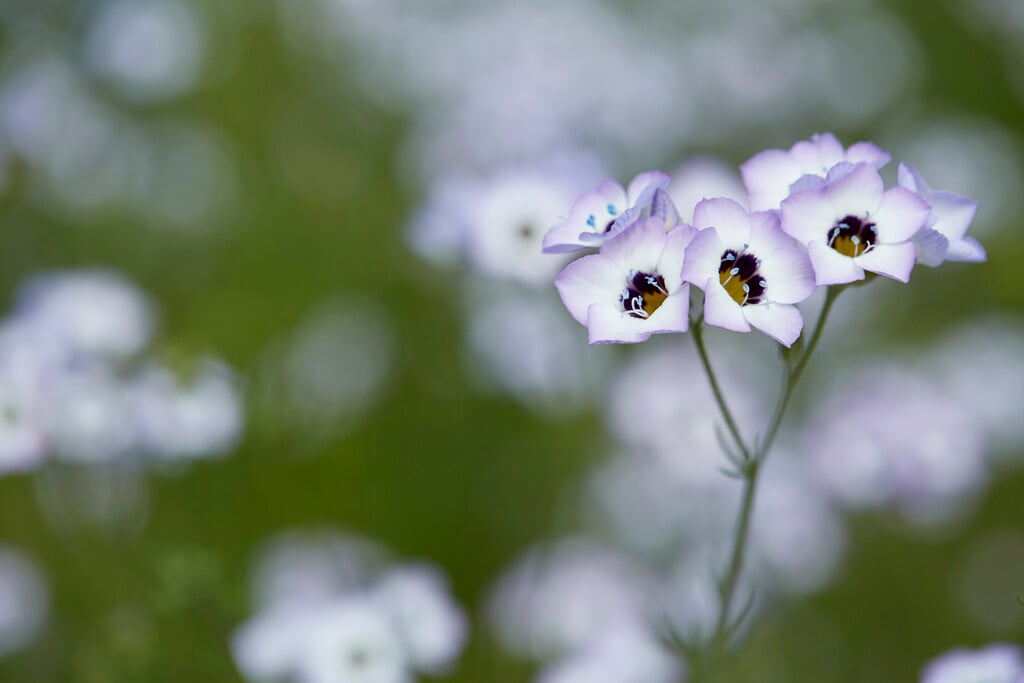
Gilia tricolor

RHS Plant Profile
birds eyes

Other common names

bird's eye

Annual Biennial

A bushy annual forming a low mound of finely divided green leaves. Saucer-shaped, pale violet flowers, with yellow throats circled with dark purple markings, are borne singly or in small clusters on slender upright stems in late spring, and sometimes again in summer

Position

Full sun

Soil Types

Chalk, Loam, Sand

Max Height

0.1-0.5 metres

Max Spread

0.1-0.5 metres

Size

Time to Maturity
1 year
Max Spread
0.1-0.5 metres
Max Height
0.1-0.5 metres

Growing Conditions

Chalk Loam Sand
Moisture
Well–drained
pH
Acid or Alkaline or Neutral

Position

Full sun
Aspect
South–facing or West–facing
Exposure
Exposed or Sheltered
Hardiness
H4

Colour & Scent

Season Stem Flower Foliage Fruit
Spring
Summer
Autumn
Winter

Botanical Details

Family
Polemoniaceae
Native to GB/Ireland
No
Foliage
Deciduous
Habit
Bushy
Genus
Gilia can be annuals or perennials, with simple or finely, pinnately divided leaves and salver-shaped or tubular, blue, pink or red flowers that may be solitary, in panicles or dense clusters
Name Status
Correct

How to Grow

Cultivation

Grow in a light, moderately fertile, well-drained soil in full sun

Propagation

Propagate by seed sown in-situ in mid-spring

Suggested planting locations and garden types

  • Cottage and informal garden
  • Gravel garden
  • Patio and container plants
  • Prairie planting
  • Wildflower meadow
  • Low Maintenance
  • Banks and slopes
  • Flower borders and beds

Pruning

Cut back after flowering if seed is not required

Pests

Generally pest-free

Diseases

Generally disease-free