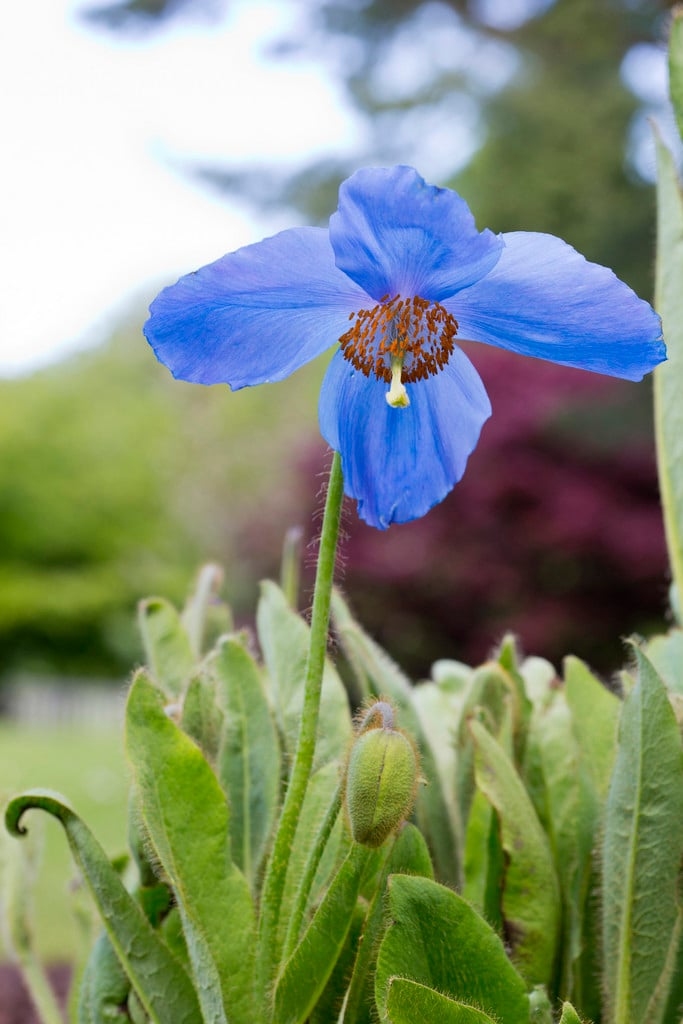
Meconopsis (Fertile Blue Group) 'Mop-head'

RHS Plant Profile
Himalayan blue poppy 'Mop-head'
Himalayan blue poppy 'Mop-head' RHS
Award of Garden Merit
Herbaceous Perennial

'Mop-Head' is a short-lived, perennial about 1m tall, forming an upright rosette of long, oval leaves with ginger hairs. In summer, erect leafy stems bear a small number of large, deep blue poppies with contrasting yellow stamens. The seed capsules, covered in bristly hairs, are decorative but contain little seed

Position

Partial shade

Soil Types

Clay, Loam

Max Height

1-1.5 metres

Max Spread

0.1-0.5 metres

Size

Time to Maturity
2–5 years
Max Spread
0.1-0.5 metres
Max Height
1-1.5 metres

Growing Conditions

Clay Loam
Moisture
Moist but well–drained
pH
Acid or Neutral

Position

Partial shade
Aspect
West–facing or East–facing
Exposure
Sheltered
Hardiness
H5

Colour & Scent

Season Stem Flower Foliage Fruit
Spring
Summer
Autumn
Winter

Botanical Details

Family
Papaveraceae
Native to GB/Ireland
No
Foliage
Deciduous
Habit
Clump forming
Genus
Meconopsis can be annuals, biennials, evergreen or herbaceous perennials, often monocarpic, with rosettes of hairy leaves and bowl-shaped flowers that may be solitary on a leafless stem, or in racemes or panicles on a leafy stem
Name Status
Accepted

How to Grow

Cultivation

Only suitable for particular sites: the soil needs to be neutral to slightly acid, moist but well-drained and enriched with leaf mould or humus to prevent stagnation; in a partially shaded site with shelter from cold, dry winds. Thrives in areas with cool, damp summers

Propagation

Propagate by division after flowering but can be short-lived

Suggested planting locations and garden types

  • Cottage and informal garden
  • Flower borders and beds

Pruning

Cut down to the base in late autumn

Pests

May be susceptible to slugs and snails

Diseases

May be susceptible to downy mildews