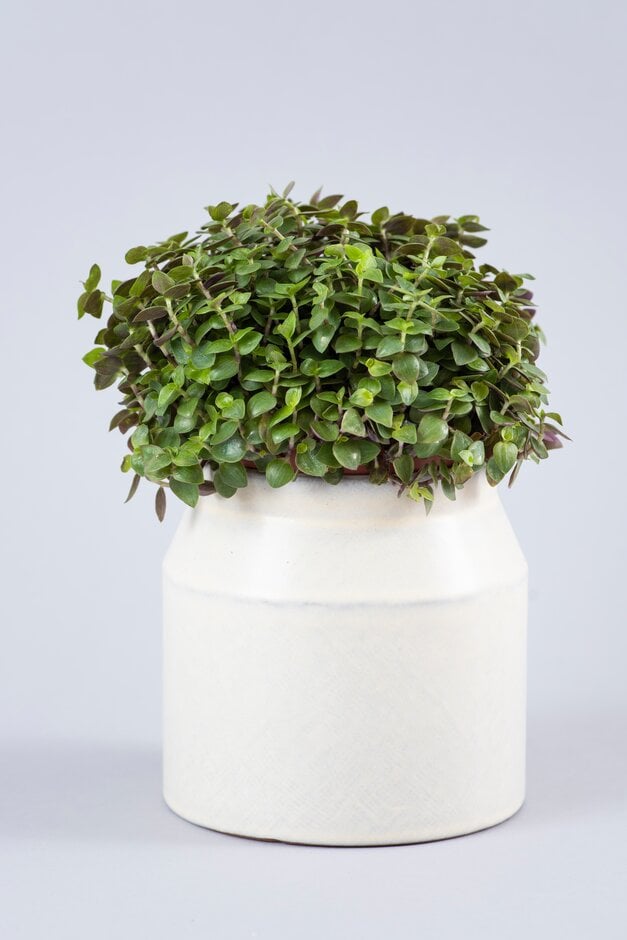
Callisia 'Turtle'

RHS Plant Profile
inch plant 'Turtle'
inch plant 'Turtle' RHS
Conservatory Greenhouse Houseplants

A tender evergreen perennial grown as a houseplant, with a trailing habit, forming mats of branching purplish stems that root at the nodes, with densely packed, slightly fleshy, pointed green leaves to 4cm long, purple beneath. Clusters of tiny white flowers are borne in the leaf axils of ascending stems in late spring and early summer. Image shows Callisia Turtle Eden Elegance

Position

Full shade, Partial shade

Soil Types

Loam

Max Height

Up to 10 cm

Max Spread

0.5-1 metres

Size

Time to Maturity
2–5 years
Max Spread
0.5-1 metres
Max Height
Up to 10 cm

Growing Conditions

Loam
Moisture
Well–drained
pH
Acid or Alkaline or Neutral

Position

Full shade Partial shade
Aspect
East–facing or North–facing or West–facing
Exposure
Sheltered
Hardiness
H1B

Colour & Scent

Season Stem Flower Foliage Fruit
Spring
Summer
Autumn
Winter

Botanical Details

Family
Commelinaceae
Native to GB/Ireland
No
Foliage
Evergreen
Habit
Matforming, Trailing
Genus
Callisia are trailing or bushy evergreen perennials with slightly fleshy stems and leaves, and small, 3-petalled white or pink flowers
Name Status
Unresolved

How to Grow

Cultivation

Grow in a hanging basket or container as a houseplant or conservatory plant, in in two parts peat-free John Innes No 2 and one part grit, in bright filtered light. Water freely from spring to summer and apply a liquid fertiliser monthly. Water to keep just moist in winter. Can be grown outdoors where temperatures do not fall below 10°C in winter. See houseplant cultivation for further advice

Propagation

Propagate by softwood cuttings, by root cuttings, removing 6-7cm of the root tip in spring, or by division, removing rooted offsets. To produce dense coverage, pot up several cuttings in an 8cm container

Suggested planting locations and garden types

  • Hanging Basket
  • Houseplants
  • Patio and container plants
  • Sub-tropical
  • Conservatory and greenhouse

Pruning

No pruning required

Pests

Generally pest-free

Diseases

Generally disease-free