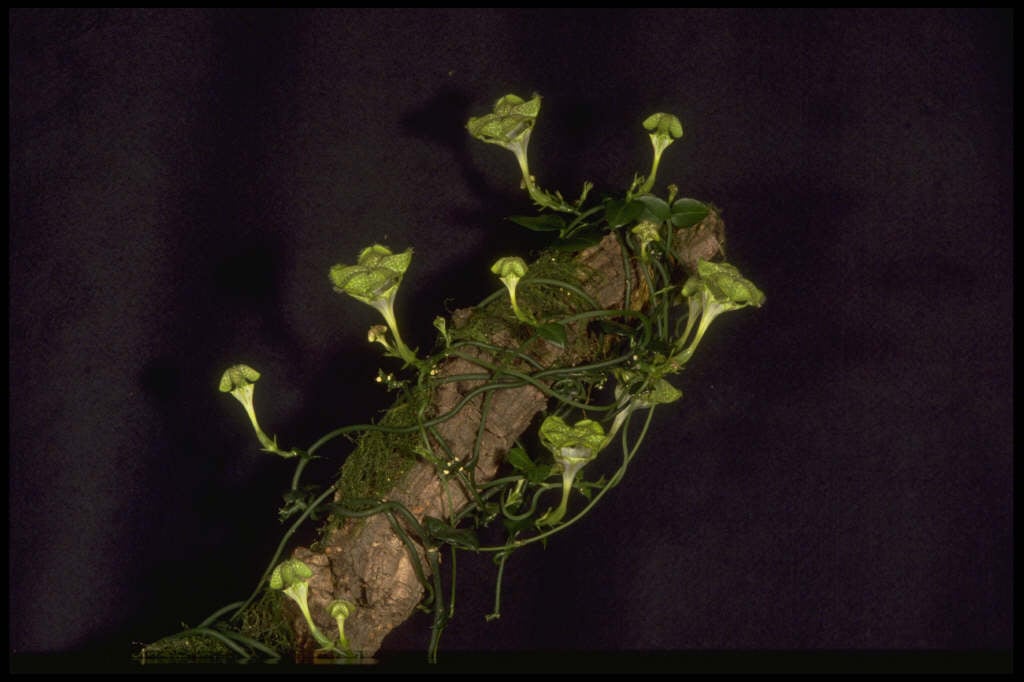
Ceropegia sandersonii

RHS Plant Profile
umbrella flower
umbrella flower www.gardenworldimages.com

Other common names

parachute plant, fountain flower, umbrella plant

Synonyms

Ceropegia monteiroi

Award of Garden Merit
Cactus Succulent Conservatory Greenhouse Climber Wall Shrub Houseplants

An evergreen succulent perennial, with twining stems bearing heart-shaped leaves and solitary green parachute-shaped flowers with a funnel-shaped tube to 5cm in length, in summer

Position

Full sun

Soil Types

Loam, Sand

Max Height

1-1.5 metres

Max Spread

0.1-0.5 metres

Size

Time to Maturity
5–10 years
Max Spread
0.1-0.5 metres
Max Height
1-1.5 metres

Growing Conditions

Loam Sand
Moisture
Well–drained
pH
Acid or Alkaline or Neutral

Position

Full sun
Aspect
South–facing or North–facing or East–facing
Exposure
Sheltered
Hardiness
H1C

Colour & Scent

Season Stem Flower Foliage Fruit
Spring
Summer
Autumn
Winter

Botanical Details

Family
Apocynaceae
Native to GB/Ireland
No
Foliage
Evergreen
Habit
Climbing
Genus
Ceropegia can be evergreen or semi-evergreen, erect, climbing to trailing, usually succulent, perennials with opposite leaves and curioously shaped flowers in summer, sometimes followed by cylindrical fruits containing silky tufted seeds
Name Status
Correct
Plant Range
S Africa, Mozam.

How to Grow

Cultivation

Grow under glass in a mixture of 2 parts sharp sand to 1 part each of loam, peat and leaf mould in bright filtered light. During the growing season feed 2 or 3 times with a low nitrogen liquid fertilizer and water moderately. Keep dry at other times

Propagation

Propagate by seed sown at 21 - 24°C in early spring or take stem cuttings and root in sand at a temperature of 22 - 25°C

Suggested planting locations and garden types

  • Patio and container plants
  • Low Maintenance

Pruning

No pruning required

Pests

May be susceptible to aphids, scale insects and mealybugs

Diseases

Generally disease-free