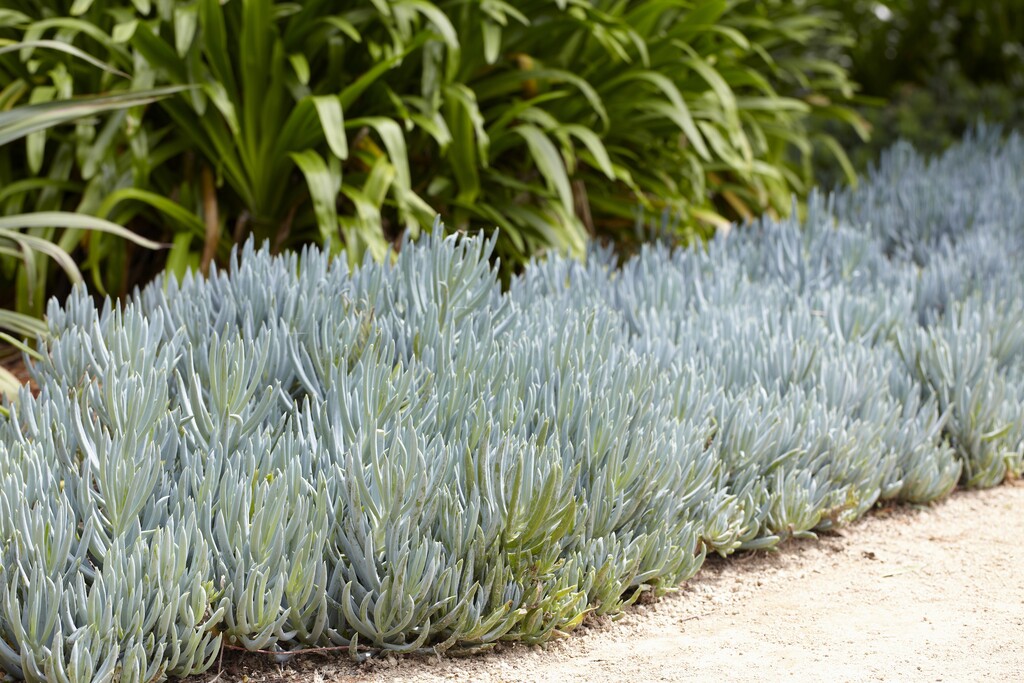
Curio talinoides subsp. mandraliscae

Synonyms

Senecio mandraliscae
Kleinia mandraliscae

Cactus Succulent

A spreading succulent to 45cm with elongated, thick, fleshy blue-grey leaves with a waxy coating. The stems are upright at first, eventually spreading out to form a dense mat. Curios flower rarely, but if they do the flowers are white and inconspicuous with no ray florets, appearing at the ends of the stems in autumn or winter after a period of dormancy

Position

Full sun

Soil Types

Loam, Sand

Max Height

0.1-0.5 metres

Max Spread

0.1-0.5 metres

Size

Time to Maturity
2–5 years
Max Spread
0.1-0.5 metres
Max Height
0.1-0.5 metres

Growing Conditions

Loam Sand
Moisture
Moist but well–drained or Well–drained
pH
Acid or Alkaline or Neutral

Position

Full sun
Aspect
East–facing or South–facing or West–facing
Exposure
Sheltered
Hardiness
H1C

Colour & Scent

Season Stem Flower Foliage Fruit
Spring
Summer
Autumn
Winter

Botanical Details

Family
Asteraceae
Native to GB/Ireland
No
Foliage
Evergreen
Habit
Columnar upright, Spreading branched
Genus
Curio are flowering evergreen succulents native to South Africa's Cape Province mountains, with long, striated leaves and disc-shaped flower heads with no ray florets
Name Status
Correct

How to Grow

Cultivation

Grow in a mix of 2 parts peat-free, loam-based potting compost and 1 part each of leaf mould and grit, in full light with good ventilation. When in growth water moderately and apply a half-strength balanced liquid feed monthly. See cactus and succulent cultivation for further advice

Propagation

Propagate by division or by removing and rooting stem sections

Suggested planting locations and garden types

  • Houseplants
  • Conservatory and greenhouse

Pruning

No pruning required

Pests

May be susceptible to aphids, glasshouse red spider mite and glasshouse whitefly

Diseases

May be susceptible to stem rots if overwatered