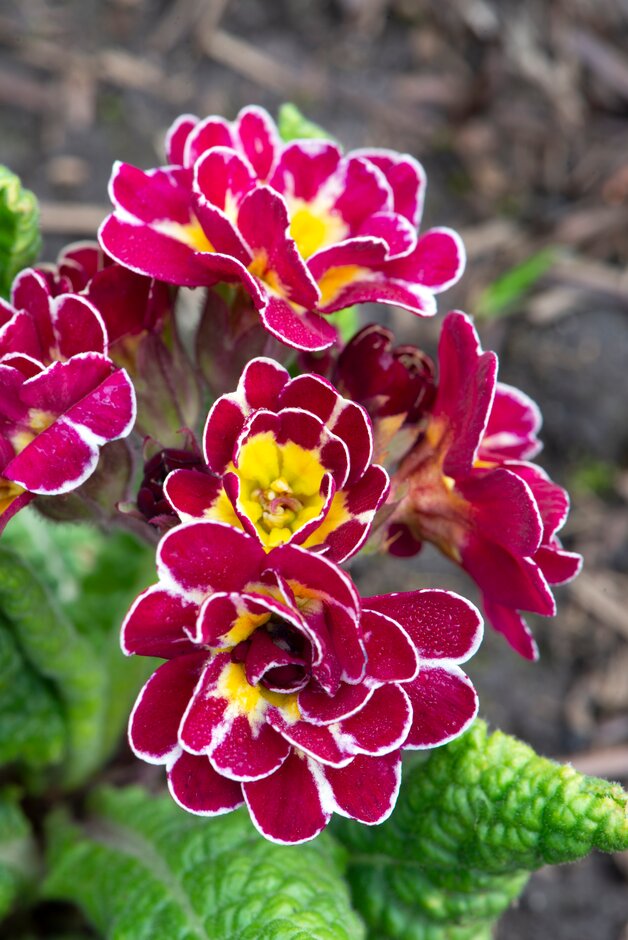
Primula vulgaris 'Tarragem Sparkling Ruby' (Pr/Prim/d)

<em>Primula</em> <em>vulgaris</em> 'Tarragem Sparkling Ruby' (Pr/Prim/d) RHS

Synonyms

Primula 'Sparkling Ruby'

Herbaceous Perennial

A compact clump-forming, semi-evergreen perennial with oblong to ovate, green leaves and, in spring, double, ruby red flowers with silver petal margins held above foliage on short, stout stems.

Position

Full sun, Partial shade

Soil Types

Loam, Clay, Chalk

Max Height

0.1-0.5 metres

Max Spread

0.1-0.5 metres

Size

Time to Maturity
2–5 years
Max Spread
0.1-0.5 metres
Max Height
0.1-0.5 metres

Growing Conditions

Loam Clay Chalk
Moisture
Moist but well–drained
pH
Neutral or Acid or Alkaline

Position

Full sun Partial shade
Aspect
West–facing or East–facing
Exposure
Sheltered
Hardiness
H6

Colour & Scent

Season Stem Flower Foliage Fruit
Spring
Summer
Autumn
Winter

Botanical Details

Family
Primulaceae
Native to GB/Ireland
No
Foliage
Semi evergreen
Habit
Clump forming
Genus
Primula are herbaceous or semi-evergreen perennials, forming a basal rosette of simple leaves, with salver-shaped or bell-shaped flowers which may be solitary or carried in an umbel or in whorls on an erect stem
Name Status
Unresolved
Horticultural Group
Primrose group primulas are mainly grown as herbaceous perennials, and produce clusters of flowers on individual stems from the basal rosettes, although a few may also have umbel-like flowers. They are either spring-flowering, if grown without protection, or winter- to spring-flowering, if grown as biennial container plants in greenhouses or indoors.

How to Grow

Cultivation

Grow in moist but free draining soil in partial shade or sun. See primula cultivation for further advice

Propagation

Propagate by seed or division

Suggested planting locations and garden types

  • City and courtyard gardens
  • Coastal
  • Cottage and informal garden
  • Hanging Basket
  • Patio and container plants
  • Flower borders and beds
  • Garden edging
  • Underplanting of roses and shrubs

Pruning

No pruning required, but any old or faded leaves can be removed if necessary

Pests

May be susceptible to some slug damage on new growth

Diseases

May be susceptible to grey moulds in damp or overcrowded situations