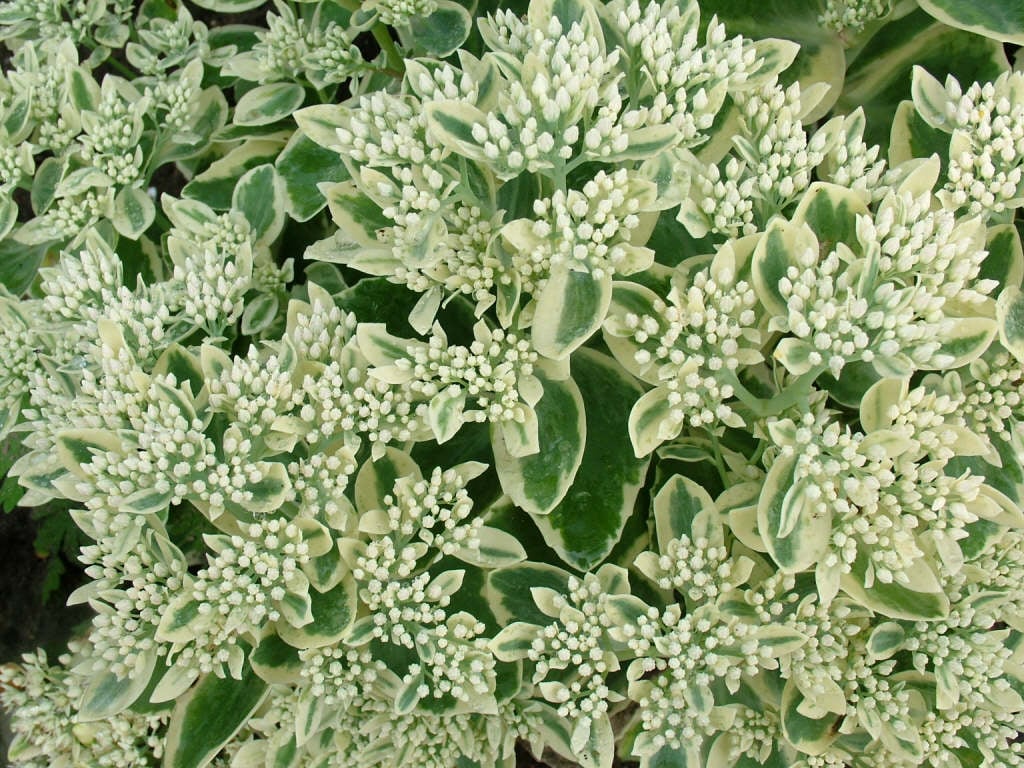
Hylotelephium erythrostictum 'Frosty Morn' (v)

RHS Plant Profile
stonecrop 'Frosty Morn'
stonecrop 'Frosty Morn' RHS

Synonyms

Sedum erythrostictum 'Frosty Morn'
Sedum alboroseum 'Frosty Morn'
Sedum 'Frosty Morn'

Herbaceous Perennial

A clump-forming deciduous perennial to 40cm tall, with rounded leaves broadly margined with white, and flat clusters of small white flowers with prominent pink carpels, in late summer

Position

Full sun

Soil Types

Chalk, Loam, Sand

Max Height

0.1-0.5 metres

Max Spread

0.1-0.5 metres

Size

Time to Maturity
2–5 years
Max Spread
0.1-0.5 metres
Max Height
0.1-0.5 metres

Growing Conditions

Chalk Loam Sand
Moisture
Moist but well–drained or Well–drained
pH
Alkaline or Neutral

Position

Full sun
Aspect
West–facing or South–facing
Exposure
Exposed or Sheltered
Hardiness
H5

Colour & Scent

Season Stem Flower Foliage Fruit
Spring
Summer
Autumn
Winter

Botanical Details

Family
Crassulaceae
Native to GB/Ireland
No
Foliage
Deciduous
Habit
Bushy
Genus
Hylotelephium are succulent perennials with heads of small star-shaped flowers in summer to autumn. They are sometimes included within the genus Sedum
Name Status
Accepted

How to Grow

Cultivation

Grow in a well-drained soil in full sun. Low soil fertility is ideal. In a rich soil, plants tend to splay outwards and not flower so well

Propagation

Propagation is by division, or leaf or stem cuttings in spring and early summer

Suggested planting locations and garden types

  • City and courtyard gardens
  • Coastal
  • Cottage and informal garden
  • Gravel garden
  • Patio and container plants
  • Garden edging
  • Flower borders and beds

Pruning

Cut back to ground level in autumn as foliage fades

Pests

Slugs, snails and aphids are the main pest problems

Diseases

Powdery mildew can be a problem especially on rich, damp soils