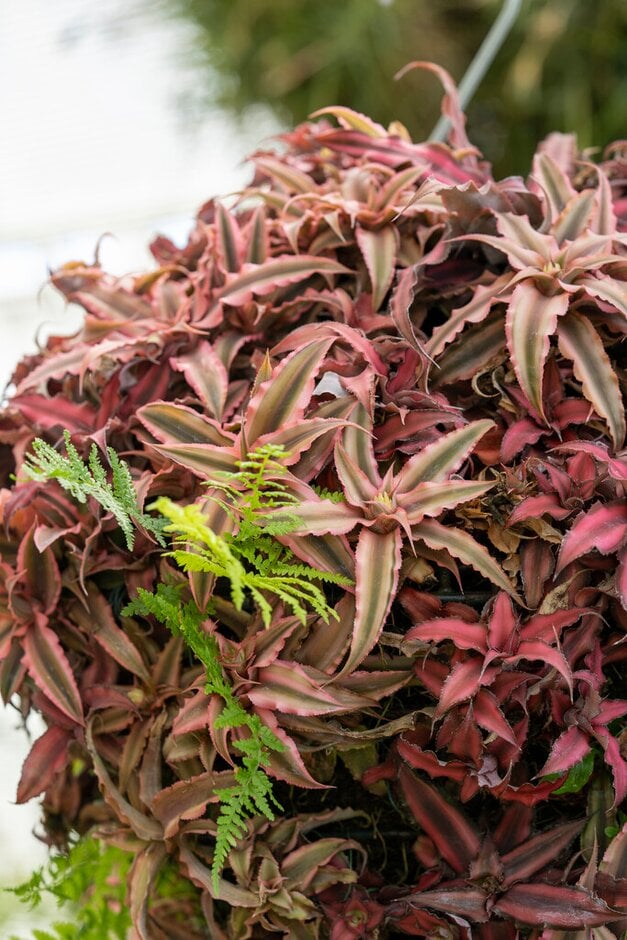
Cryptanthus bivittatus

RHS Plant Profile
earth star
earth star RHS / Visions Pictures

Synonyms

Cryptanthus bivittatus var. atropurpureus

Award of Garden Merit

A stemless bromeliad forming a low, spreading rosette about 30cm across. The rosettes are composed of strap-shaped, toothed, wavy-margined leaves, with pale green or pink stripes. An ideal plant for terrariums and bottle gardens

Position

Full sun, Partial shade

Soil Types

Loam, Sand

Max Height

Up to 10 cm

Max Spread

0.1-0.5 metres

Size

Time to Maturity
2–5 years
Max Spread
0.1-0.5 metres
Max Height
Up to 10 cm

Growing Conditions

Loam Sand
Moisture
Moist but well–drained
pH
Acid

Position

Full sun Partial shade
Aspect
East–facing or South–facing or West–facing
Exposure
Sheltered
Hardiness
H1A

Colour & Scent

Season Stem Flower Foliage Fruit
Spring
Summer
Autumn
Winter

Botanical Details

Family
Bromeliaceae
Native to GB/Ireland
No
Foliage
Evergreen
Habit
Matforming
Genus
Cryptanthus are evergreen, rosette-forming perennials with leathery, wavy-edged, strap-shaped leaves, often attractively variegated, and inconspicuous, usually fragrant, greenish-white flowers in summer
Name Status
Correct
Plant Range
E. Brazil

How to Grow

Cultivation

Grow indoors as a houseplant or under glass in a terrestrial bromeliad compost. Position in bright, filtered light and maintain moderate to high humidity. When in growth water moderately but carefully and apply a dilute liquid fertiliser monthly; water sparingly in winter. See Bromeliad cultivation for further information. An ideal plant for terrariums and bottle gardens

Propagation

Propagate by seed sown as soon as ripe at 27°C, or remove offsets in early summer

Suggested planting locations and garden types

  • Houseplants
  • Patio and container plants
  • Sub-tropical
  • Low Maintenance
  • Conservatory and greenhouse

Pruning

No pruning required

Pests

Generally pest-free

Diseases

May be susceptible to root rot