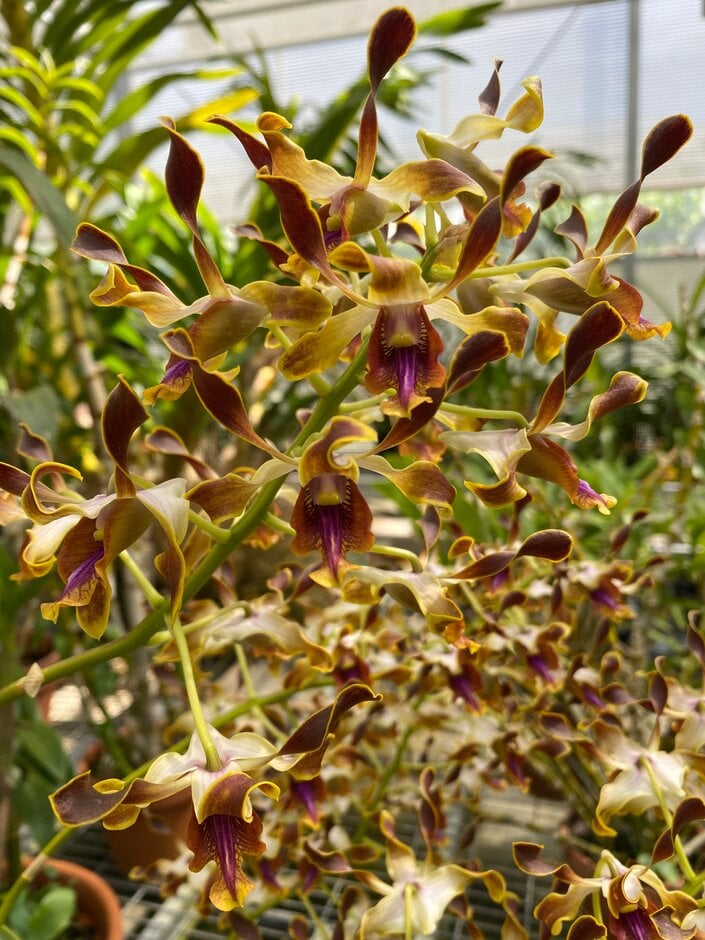
Dendrobium antennatum × helix 'Pomio Brown'

<em>Dendrobium</em> <em>antennatum</em> × <em>helix</em> 'Pomio Brown' Valeria Valkova
Conservatory Greenhouse Houseplants

A medium to large-sized, evergreen orchid with long, upright, cane-like stems (pseudobulbs), up to 100cm tall. Bright green leaves are arranged along the cane nodes, stiff and up to 15cm long and 3-5cm wide. The flowering stems measuring up to 50cm emerge from the upper nodes of mature pseudobulbs and carry 3 to 20 flowers. The flowers are waxy and long-lasting, approximately 5cm across. The petals are yellow or brown, often spirally twisted and pointing upwards - resembling an antelope

Position

Full sun, Partial shade

Max Height

0.5-1 metres

Max Spread

0.5-1 metres

Size

Time to Maturity
5–10 years
Max Spread
0.5-1 metres
Max Height
0.5-1 metres

Growing Conditions

Moisture
Well–drained
pH
Neutral

Position

Full sun Partial shade
Aspect
East–facing or South–facing or West–facing
Exposure
Exposed or Sheltered
Hardiness
H1A

Colour & Scent

Season Stem Flower Foliage Fruit
Spring
Summer
Autumn
Winter

Botanical Details

Family
Native to GB/Ireland
No
Foliage
Evergreen
Habit
Clump forming, Columnar upright
Genus
Name Status

How to Grow

Cultivation

Plants are best grown in a pot in an epiphytic, medium grade, bark-based potting mix with addition of sustainably sourced perlite, moss, or coir. As with many orchids, they grow best when the roots are slightly restricted. Therefore, avoid over-potting or frequent root disturbance. It is a warm-growing orchid and the temperatures should not drop below 16°C. Provide very bright light conditions and 80% humidity throughout the year. See indoor orchid cultivation

Propagation

Propagation by seed is only possible in controlled laboratory environment. Mature plants may be divided when the plant overgrows the pot. Sideshoots (keiki) may develop on older canes - remove and pot them into sustainably farmed sphagnum moss when the new roots are at least 2cm long.

Suggested planting locations and garden types

  • Houseplants
  • Conservatory and greenhouse

Pruning

No pruning required. Remove spent flowers as necessary, but do not cut the whole cane unless completely shrivelled. Oldest canes may be removed as long as there are at least three, younger, thick, leaf-bearing canes on the plant.

Pests

May be susceptible to scale insects, aphids, mealybugs and red spider mite

Diseases

Generally disease-free