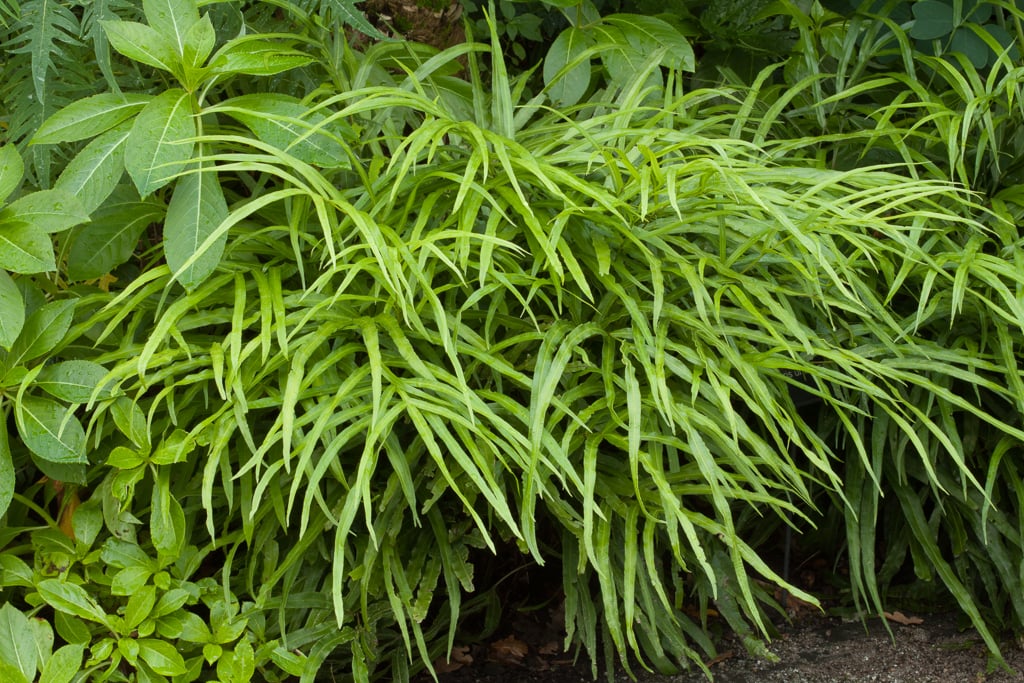
Pteris umbrosa

RHS Plant Profile
jungle brake
jungle brake John Fielding
Ferns

A slightly tender, clump-forming, evergreen fern with erect fronds divided into long, wavy, broadly linear to narrowly lance-shaped, glossy leaflets

Position

Full shade, Partial shade

Soil Types

Loam, Chalk, Sand

Max Height

0.5-1 metres

Max Spread

0.5-1 metres

Size

Time to Maturity
5–10 years
Max Spread
0.5-1 metres
Max Height
0.5-1 metres

Growing Conditions

Loam Chalk Sand
Moisture
Moist but well–drained
pH
Neutral or Alkaline

Position

Full shade Partial shade
Aspect
East–facing or West–facing or North–facing
Exposure
Sheltered
Hardiness
H3

Colour & Scent

Season Stem Flower Foliage Fruit
Spring
Summer
Autumn
Winter

Botanical Details

Family
Pteridaceae
Native to GB/Ireland
No
Foliage
Evergreen
Habit
Clump forming
Genus
Pteris can be evergreen, semi-evergreen or deciduous ferns, with short or long rhizomes and fronds that may be pinnate to 4-pinnate
Name Status
Correct
Plant Range
E Australia

How to Grow

Cultivation

Grow in moist but well-drained soil with added leaf mould in partial shade or full shade. Can also be grown in a cool greenhouse or as a houseplant if kept away from central heating. See how to grow tender ferns outdoors or how to grow ferns as houseplants for further advice

Propagation

Propagate by division or spores

Suggested planting locations and garden types

  • Sub-tropical
  • Patio and container plants
  • Cottage and informal garden
  • City and courtyard gardens
  • Houseplants
  • Underplanting of roses and shrubs
  • Flower borders and beds

Pruning

No pruning required

Pests

Generally pest-free

Diseases

Generally disease-free