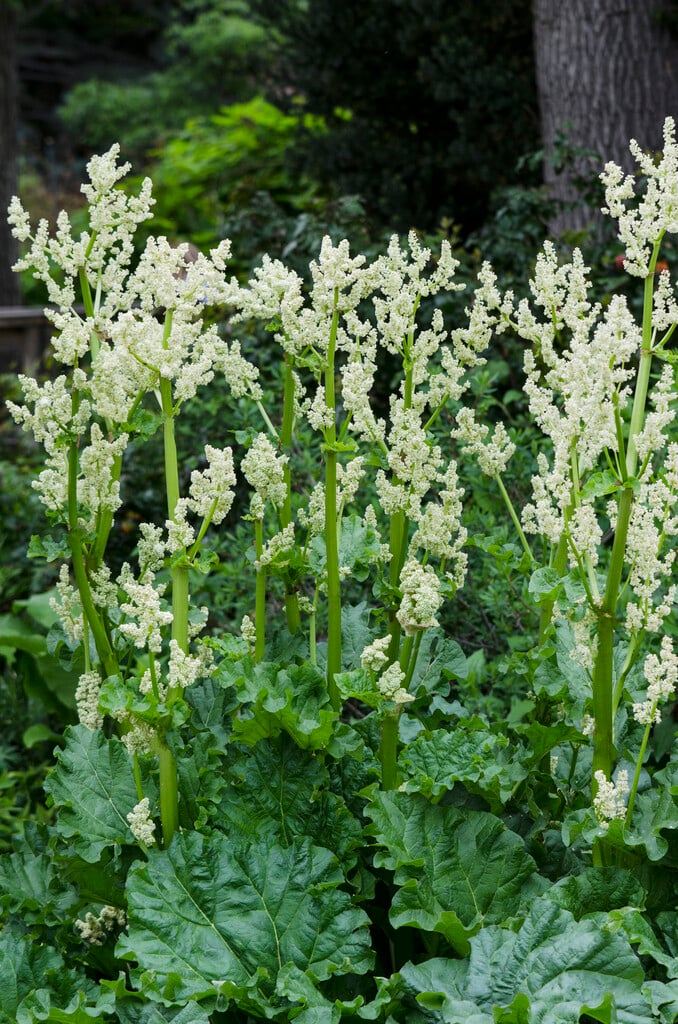
Rheum australe

RHS Plant Profile
Himalayan rhubarb
Himalayan rhubarb visionspictures.com

Other common names

Nepal rhubarb, red-veined Himalayan rhubarb, red-veined pie plant, Indian rhubarb

Synonyms

Rheum emodi

Herbaceous Perennial

A large rhizomatous perennial to 2m high, with oval to rounded basal leaves up to 75cm long that emerge from the ground in late spring. Leaves are mid green, with wavy edges, coarse hairs on the undersides and long, thick reddish stems; they are sometimes bronze when young and tinted red in autumn. In summer, produces tall, branching flower stems, bearing tiny, densely packed, nodding reddish-purple flowers. An ornamental plant grown for its striking substance

Position

Full sun, Partial shade

Soil Types

Clay, Loam

Max Height

1.5-2.5 metres

Max Spread

1.5-2.5 metres

Size

Time to Maturity
2–5 years
Max Spread
1.5-2.5 metres
Max Height
1.5-2.5 metres

Growing Conditions

Clay Loam
Moisture
Moist but well–drained
pH
Acid or Neutral

Position

Full sun Partial shade
Aspect
East–facing or South–facing or West–facing
Exposure
Exposed or Sheltered
Hardiness
H6

Colour & Scent

Season Stem Flower Foliage Fruit
Spring
Summer
Autumn
Winter

Botanical Details

Family
Polygonaceae
Native to GB/Ireland
No
Foliage
Deciduous
Habit
Clump forming
Potentially harmful
Harmful if eaten. Wear gloves and other protective equipment when handling Pets: Harmful if eaten - for further information and contact numbers regarding pets, see the HTA guide to potentially harmful plants
Genus
Rheum are robust rhizomatous herbaceous perennials with large, simple or palmately lobed leaves and tall leafy stems bearing large panicles of tiny flowers
Name Status
Correct

How to Grow

Cultivation

Grow in deep, moist, fertile soil, ideally in a sunny position. Mulch with organic matter in early spring. Needs plenty of space

Propagation

Propagate by seed, sown in containers in a cold frame in autumn, or by division in early spring

Suggested planting locations and garden types

  • Architectural
  • Cottage and informal garden
  • Flower borders and beds

Pruning

Cut back faded leaves at the end of the season

Pests

May be susceptible to slugs and aphids

Diseases

May be susceptible to crown rot, honey fungus and virus diseases