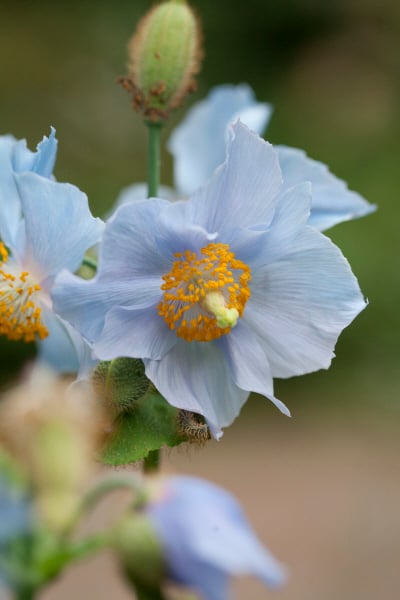
Meconopsis baileyi

RHS Plant Profile
Bailey's Himalayan blue poppy
Bailey's Himalayan blue poppy Dorling Kindersley Ltd

Synonyms

Meconopsis betonicifolia misapplied

Award of Garden Merit
Herbaceous Perennial

A short-lived, clump-forming perennial to 1.2m in height, forming a rosette of hairy, oblong leaves. Erect leafy stems bear a succession of clear blue poppies 8-10cm in width with contrasting yellow stamens and a short style

Position

Partial shade

Soil Types

Clay, Loam

Max Height

1-1.5 metres

Max Spread

0.1-0.5 metres

Size

Time to Maturity
2–5 years
Max Spread
0.1-0.5 metres
Max Height
1-1.5 metres

Growing Conditions

Clay Loam
Moisture
Moist but well–drained
pH
Acid or Neutral

Position

Partial shade
Aspect
West–facing or East–facing
Exposure
Sheltered
Hardiness
H5

Colour & Scent

Season Stem Flower Foliage Fruit
Spring
Summer
Autumn
Winter

Botanical Details

Family
Papaveraceae
Native to GB/Ireland
No
Foliage
Deciduous
Habit
Clump forming
Genus
Meconopsis can be annuals, biennials, evergreen or herbaceous perennials, often monocarpic, with rosettes of hairy leaves and bowl-shaped flowers that may be solitary on a leafless stem, or in racemes or panicles on a leafy stem
Name Status
Correct
Plant Range
E Himalaya,Tibet, Myanmar

How to Grow

Cultivation

Only suitable for particular sites: the soil needs to be neutral to slightly acid, moist but well-drained and enriched with leaf mould or humus to prevent stagnation; in a partially shaded site with shelter from cold, dry winds. Thrives in areas with cool damp summers

Propagation

Propagate by seed or by division after flowering but can be short-lived

Suggested planting locations and garden types

  • Cottage and informal garden
  • Flower borders and beds
  • Underplanting of roses and shrubs

Pruning

Cut down to the base in late autumn

Pests

May be susceptible to slugs and snails

Diseases

May be susceptible to downy mildews