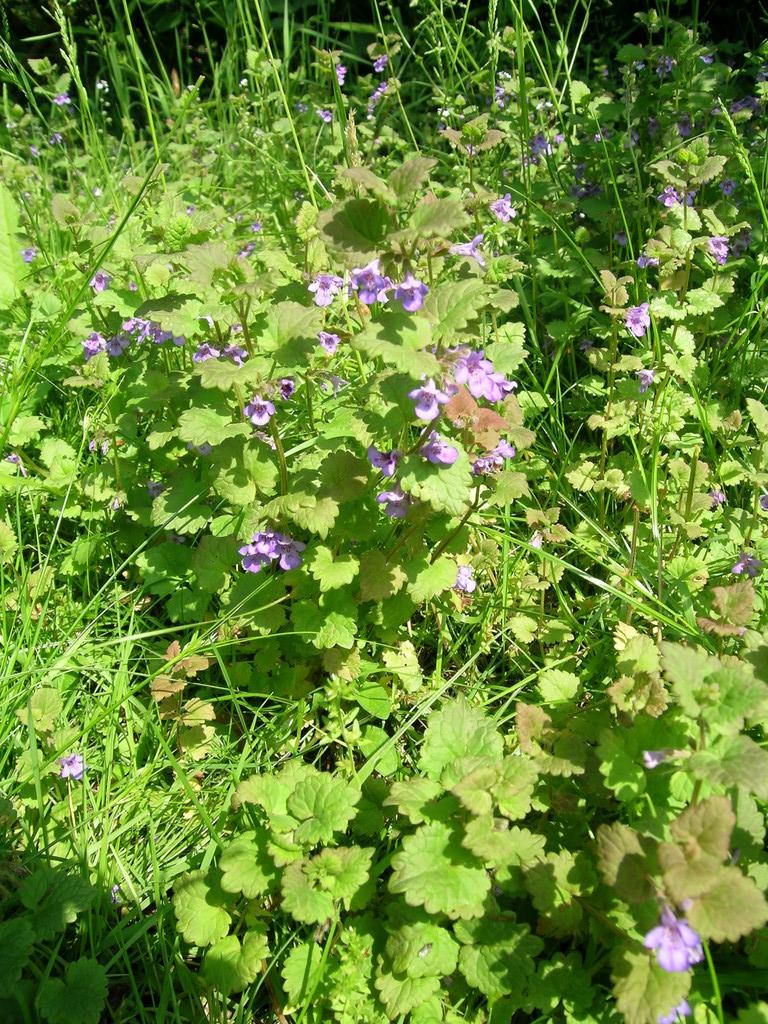
Glechoma hederacea

RHS Plant Profile
ground ivy
ground ivy RHS

Other common names

ale gill, alehoof, blue runner, candlesticks, cat's foot, cat's paws, creeping Charlie, creeping Jenny, crow victuals, crow's guts, devil's candlestick, field balm, field balsam, Gill, Gill-go-by-the-street, Gill-over-the-ground, Gill-run-over, hay maids, hayfoot, hayhoof, hedge maids, hen and chickens, hove, Jill-on-the-ground, purple chickweed, Robin-run-away, Robin-run-in-the-hedge, runaway Robin, tunhoof, turnhoof, wandering Jenny, wild snakeroot, eidral

Herbaceous Perennial

A vigorous spreading, mat-forming evergreen perennial, creeping by prostrate stolons. Flowering stems sub-erect, to 10cm. Flowers are commonly violet-blue, but pink and white forms also occur

Position

Full sun, Partial shade

Soil Types

Chalk, Clay, Loam, Sand

Max Height

0.1-0.5 metres

Max Spread

0.1-0.5 metres

Size

Time to Maturity
2–5 years
Max Spread
0.1-0.5 metres
Max Height
0.1-0.5 metres

Growing Conditions

Chalk Clay Loam Sand
Moisture
Moist but well–drained
pH
Acid or Alkaline or Neutral

Position

Full sun Partial shade
Aspect
South–facing or West–facing or East–facing
Exposure
Exposed
Hardiness
H6

Colour & Scent

Season Stem Flower Foliage Fruit
Spring
Summer
Autumn
Winter

Botanical Details

Family
Lamiaceae
Native to GB/Ireland
Yes
Foliage
Evergreen
Habit
Matforming
Genus
Glechoma are perennial herbs with long, trailing stolons, roundish crenate-serrate opposite leaves, and small labiate flowers in whorls in the leaf axils, usually blue
Name Status
Correct
Plant Range
Eurasia

How to Grow

Cultivation

Grow in moderately fertile, moist but well-drained soil in full sun or partial shade. Tolerates a range of soils and positions

Propagation

Propagate by division in spring or autumn, or by softwood cuttings in late spring

Suggested planting locations and garden types

  • Wildlife gardens
  • Low Maintenance
  • Ground cover
  • Banks and slopes
  • Underplanting of roses and shrubs

Pruning

Prune as required to keep under control

Pests

May be susceptible to slugs and snails

Diseases

Generally disease-free