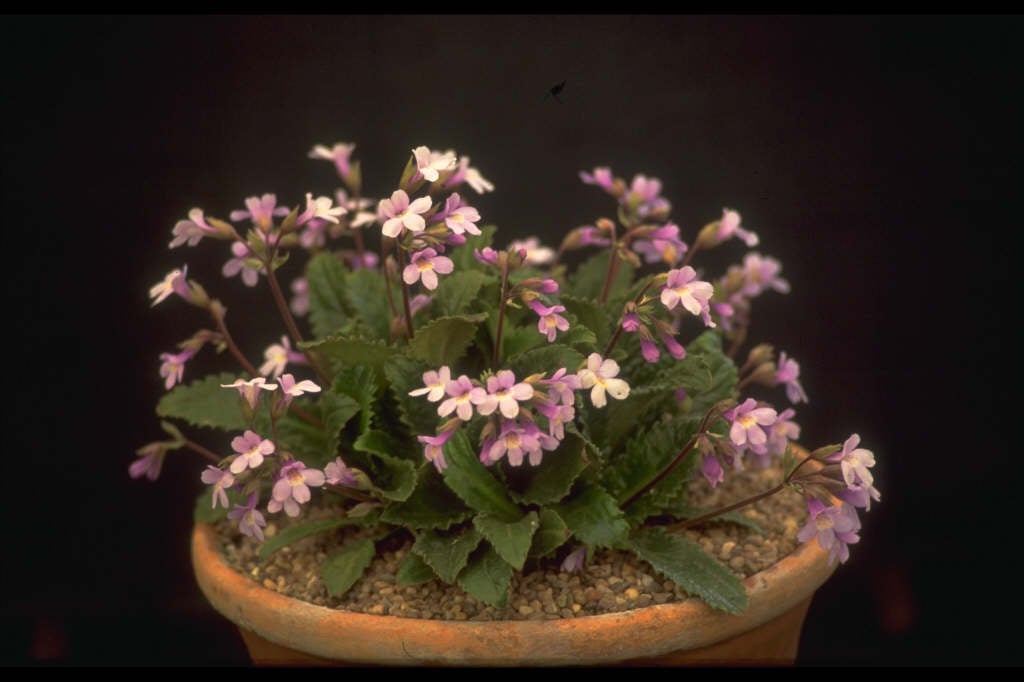
Haberlea rhodopensis

RHS Plant Profile
Orpheus flower
Orpheus flower www.gardenworldimages.com

Other common names

Rhodope haberlea, resurrection plant

Synonyms

Haberlea ferdinandi-coburgii

Award of Garden Merit
Alpine Rockery

A perennial to 15cm in height, forming a rosette of hairy, dark green, obovate leaves to 8cm in length, with scalloped edges, and with 2-lipped, light violet flowers 2.5cm in width, marked orange on the white throat

Position

Full shade, Partial shade

Soil Types

Chalk, Loam, Sand

Max Height

0.1-0.5 metres

Max Spread

0.1-0.5 metres

Size

Time to Maturity
2–5 years
Max Spread
0.1-0.5 metres
Max Height
0.1-0.5 metres

Growing Conditions

Chalk Loam Sand
Moisture
Moist but well–drained
pH
Acid or Alkaline or Neutral

Position

Full shade Partial shade
Aspect
East–facing or South–facing or West–facing
Exposure
Sheltered
Hardiness
H5

Colour & Scent

Season Stem Flower Foliage Fruit
Spring
Summer
Autumn
Winter

Botanical Details

Family
Gesneriaceae
Native to GB/Ireland
No
Foliage
Evergreen
Habit
Clump forming
Genus
Haberlea are evergreen perennials, forming a stemless rosette of obovate leaves, with unbels of 2-lipped, shortly funnel-shaped flowers in spring and early summer
Name Status
Correct
Plant Range
Bulgaria, Greece

How to Grow

Cultivation

Grow in a moist but well-drained, humus-rich, gritty, acid to neutral soil in full or partial shade. Protect from excessive winter wet and cold winds. Best grown in vertical rock crevices to avoid the accumulation of water in foliage rosettes. Root disturbance is resented

Propagation

Propagate by seed or root leaf cuttings in spring

Suggested planting locations and garden types

  • Patio and container plants
  • Rock garden

Pruning

No pruning required

Pests

May be susceptible to slugs and snails

Diseases

Generally disease-free