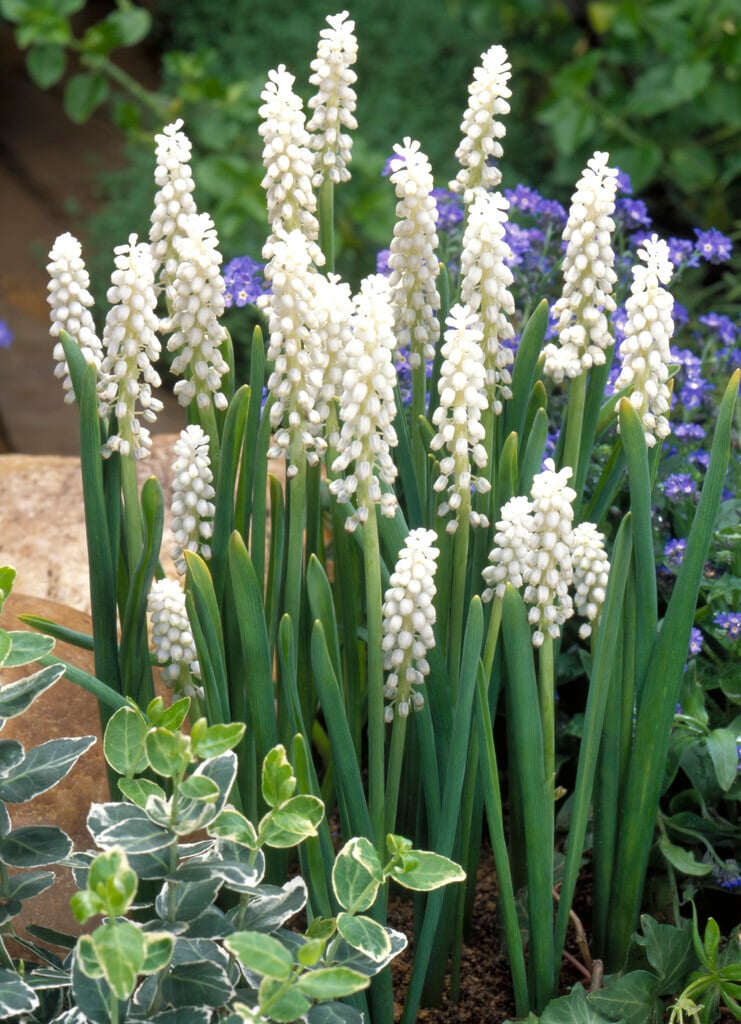
Muscari botryoides

RHS Plant Profile
compact grape hyacinth

Other common names

sky-blue grape hyacinth, baby's breath, bluebottle, starch flower, Greek grape hyacinth

Synonyms

Botryanthus vulgaris
Muscari heldreichii

Bulbs

A clump-forming, bulbous perennial to 20cm high, with narrow, linear green leaves with incurved margins. In spring, produces densely packed spikes of globe-shaped, bright blue flowers with white mouths. Spikes become looser as the flowers mature.

Position

Full sun

Soil Types

Chalk, Clay, Loam, Sand

Max Height

0.1-0.5 metres

Max Spread

0.1-0.5 metres

Size

Time to Maturity
1–2 years
Max Spread
0.1-0.5 metres
Max Height
0.1-0.5 metres

Growing Conditions

Chalk Clay Loam Sand
Moisture
Moist but well–drained or Well–drained
pH
Acid or Alkaline or Neutral

Position

Full sun
Aspect
South–facing
Exposure
Exposed or Sheltered
Hardiness
H6

Colour & Scent

Season Stem Flower Foliage Fruit
Spring
Summer
Autumn
Winter

Botanical Details

Family
Asparagaceae
Native to GB/Ireland
No
Foliage
Deciduous
Habit
Clump forming
Potentially harmful
Ornamental bulbs - not to be eaten. Wear gloves and other protective equipment when handling Pets: Ornamental bulbs - not to be eaten - see the HTA guide to potentially harmful plants for further information and useful contact numbers
Genus
Muscari are bulbous perennials with linear or strap-shaped leaves and small bell-shaped, tubular or urn-shaped flowers borne in a dense raceme on an erect leafless stem
Name Status
Correct
Plant Range
France to Ukraine

How to Grow

Cultivation

Plant 10cm deep in autumn in any moderately fertile, well-drained soil. Lift and divide (when dormant in summer) congested clumps to maintain vigour

Propagation

Propagate by seed, sown in containers in a cold frame as soon as ripe, or by division, separating offsets when dormant

Suggested planting locations and garden types

  • City and courtyard gardens
  • Cottage and informal garden
  • Gravel garden
  • Patio and container plants
  • Rock garden
  • Wildflower meadow
  • Wildlife gardens
  • Banks and slopes
  • Garden edging

Pruning

No pruning required

Pests

Generally pest-free

Diseases

May be susceptible to fungal infections including anther smuts and bluebell rust (see rust diseases), and bacterial soft rot and some virus diseases