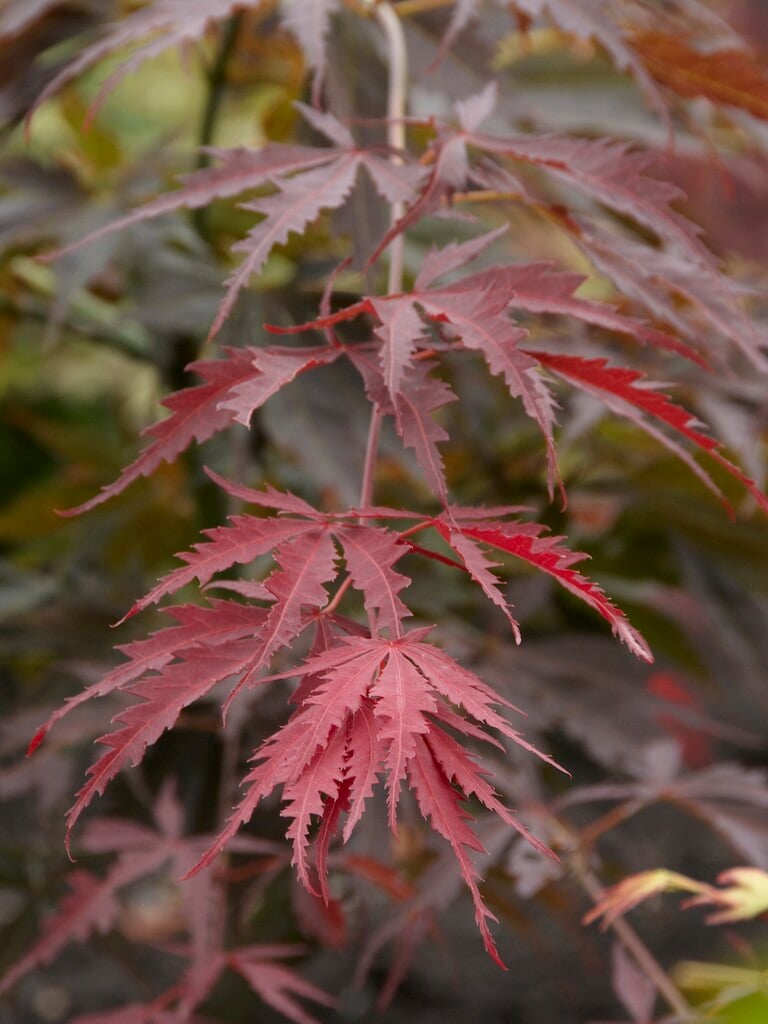
Acer palmatum 'Hessei' (M)
Japanese maple 'Hessei'
A deciduous shrub or small tree, to around 1.2m high, with a spreading habit and deeply cut leaves divided to the base into long narrow lobes. Leaves emerge strongly flushed with red, and deepen to olive green and purple-bronze over summer before turning bright red again in autumn
Synonyms
Acer palmatum 'Laciniatum Purpureum'Acer palmatum 'Elegans Purpureum'
see moreAcer palmatum 'Septemlobum Purpureum'
Acer palmatum 'Heptalobum Elegans Purpureum'

Buy this plant
Size
Ultimate height
1–1.5 metresTime to ultimate height
5–10 yearsUltimate spread
1–1.5 metresGrowing conditions
Moisture
Moist but well–drainedpH
Acid, NeutralColour & scent
| Stem | Flower | Foliage | Fruit | |
| Spring | Red Green | |||
|---|---|---|---|---|
| Summer | Green Bronze Purple | |||
| Autumn | Red Green | |||
| Winter |
Position
- Full sun
- Partial shade
Aspect
East–facing or South–facing or West–facing
Exposure
Sheltered Hardiness
H6Botanical details
- Family
- Sapindaceae
- Native to GB / Ireland
- No
- Foliage
- Deciduous
- Habit
- Spreading branched
- Genus
Acer can be deciduous trees or large shrubs with paired, often palmately-lobed leaves and small flowers followed by characteristic winged fruits. Many have fine autumn colour, and some have ornamental stems
- Name status
Accepted
How to grow
Cultivation
Grow in moisture-retentive, well-drained, ideally slightly acidic soil, in a sheltered position with protection from drying winds. Thrives in part shade, as some sun is needed to develop the leaf colour, but will tolerate full sun if soil is reliably moist. Mulch in spring, especially when grown in containers, to improve moisture retention. See Japanese maples cultivation
Propagation
Suggested planting locations and garden types
- City and courtyard gardens
- Cottage and informal garden
- Patio and container plants
- Low Maintenance
- Flower borders and beds
Pruning
Minimal pruning required; see pruning group 1. Prune from late autumn to mid-winter only
Pests
May be susceptible to Acer gall mite, aphids, caterpillars and horse chestnut scale
Diseases
May be susceptible to Verticillium wilt, Acer leaf scorch and honey fungus
Get involved
The Royal Horticultural Society is the UK’s leading gardening charity. We aim to enrich everyone’s life through plants, and make the UK a greener and more beautiful place.