Quick Facts
Easy to grow
1
Flowers in spring but use specially prepared bulbs for flowering earlier indoors
2
Plant bulbs in early autumn
3
Prefers sun or partial shade
4
Cut the flower stalk off at the base after flowering
5
Water and feed until the foliage yellows
6
Bulbs increase slowly by producing offsets (small bulbs)
7


Before you get started
Choosing a hyacinth
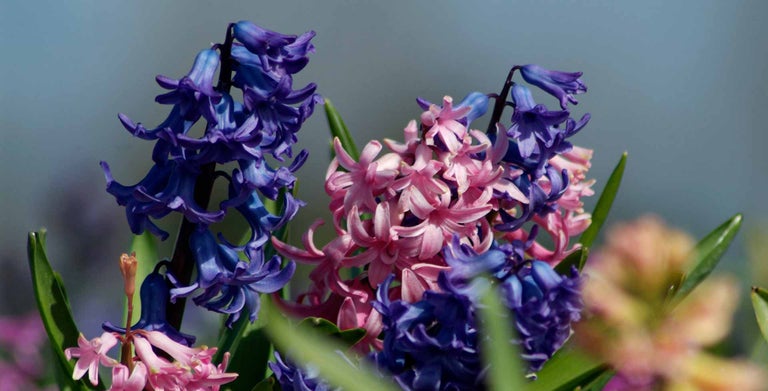
Hyacinths come in a wide range of vibrant colours with a distinctive scent, making them ideal for a spring displays. There’s not much difference between them other than the colour, so choose those you really like.
If you’re still stumped, then take a look at the hyacinths that were given the RHS Award of Garden Merit (AGM) following our trial. These were chosen for good garden display and are part of our recommended choices.
Buying hyacinths
Hyacinth are available in late summer to autumn from garden centres and online. For suppliers of specific cultivars use the RHS Find a Plant tool.
For most hyacinths, you’ll see the same is offered for sale as two types:
- Bulbs sold for spring flowering. These are perfect for planting in borders and containers outdoors, but can also be grown initially outside and bought into the house in bloom in spring
- Prepared bulbs for flowering at Christmas time, or just after, depending on when you plant (see When to plant hyacinths below). These have been specially treated with heat to initiate the earlier display. They’re usually a bit more expensive as a result
Planting
When to plant hyacinths
Plant outdoors in borders and containers in early autumn for flowering in March and April.
Prepared bulbs should be planted in September if you want blooms for Christmas flowering, as they require 10-12 weeks for good root and shoot development.
Where to plant hyacinths
Hyacinths are ideal for borders and containers, particularly close to paths or doors so you can appreciate their heady perfume. They prefer well-drained, moderately fertile soil in full sun if they are going to remain in one place for a few years. They will also tolerate partial shade for a one-off display, but they will bloom less well in the following years if left there.
They are fully hardy in the ground, but can be frost tender in containers in cold gardens and sever winters.
How to plant hyacinths
In borders
Plant your bulbs with their noses held high and 10cm (4in) deep. Bulbs need a minimum gap between them of 7.5cm (3in). Water after planting to settle them in.
Bulb performance and flower quality usually declines in the years after planting. This is because the spectacular flowering of fresh bulbs is due to the fertile conditions under which they are grown and post-harvest treatment that induces dense spikes of large flowers. So, for the tip-top blooms, replace each year. Alternatively, the smaller blooms still make attractive displays so either just enjoy this or supplement the display with a few new bulbs each autumn to keep it looking good.
In containers
Use any peat-free multi-purpose potting or make your own by mixing two-parts John Innes No. 2 compost with one-part grit to improve drainage.
- Grow several (at least three/five) bulbs in a container for bold displays. Plant your bulbs 10cm (4in) deep and about 7.5cm (3in) apart. Raise the large container to improve drainage by placing it on ‘pot feet’ or bricks. You can protect the container from frost damage in winter by wrapping with re-used bubble plastic or hessian, or moving it to a sheltered location
- Plant individually in 9cm (3½in) pots for in a sheltered place, such as a . In spring, select those about to bloom at the same time and pot up together for indoor enjoyment
After flowering indoors, move the containers to a sheltered spot in the garden and feed as directed below to encourage flowering next year. Alternatively, tip them out and plant them in the garden in a sunny spot.
Indoor displays using ‘prepared’ bulbs
Use peat-free multipurpose compost for pots with drainage holes. Bulb fibre is better when planting containers without drainage holes (it’s designed to hold water but not get too soggy). Next, arrange the bulbs closer than 7.5cm (3in) together, but don’t allow them to touch.
You can also grow prepared bulbs in water in special clear bulb vases (available at garden centres). The water should be kept just below the bottom of the bulb but not touching it. Pieces of charcoal in the water help to keep it sweet and stop slime developing but are not essential. Place the bulb in a dark, cool place until the vase is full of roots and the flower stems emerge. Then gradually increase the amount of light and warmth. Bulbs are usually discarded after flowering; but you can always give them a go in the garden if you want to see what happens next year.
Ongoing Care
Watering
- Keep the moist during growing and flowering, but reduce the water once the leaves begin to die off naturally
- Be careful not to over water indoor containers without drainage as the bulbs will rot. Push your finger into the and only add more water if it feels dry (rather than moist or damp)
Feeding
- In containers, apply a liquid high-potassium feed, such as tomato fertiliser, from early spring until six weeks after flowering. Always follow the dosage instructions and frequency on the pack
- No feeding is required for bulbs grown in water in glass vases
Staking
The flower heads are often so large that they flop over as they develop. Carefully insert a pea stick/small next into the soil by the bulb and use garden to secure the bloom. When you are visiting gardens you will see that they sometimes push the stake through the bulb, but this is not a good idea if you want to keep the bulb for another year as it causes damage.
Dead heading
- Cut off the flower stalk at the base when the flowers fade
Storage
- As the foliage begins to yellow, stop watering containers
- Once all the foliage has died down you can lift the bulbs, clean off the soil and store them in a cool dry place for replanting in the autumn
- If you have well drained soil you can leaves the bulbs in the ground to flower next year
Propagating
Hyacinth cultivars can only be propagated by producing offsets (baby ), scaling, chipping or scooping. These are slow processes so, given that bulbs are very affordable, most gardeners just buy new ones. However, if you’d like to have a go at the intriguing process of scooping, which results in bulbs that flower in three- or four-year’s time, this is what to do:
Scooping
- After the foliage has died off, lift the bulbs and remove the soil and select only large, healthy bulbs for propagation.
- With scooping, all of the basal plate of a healthy, dormant bulb is scooped out using a sterilised, sharpened teaspoon or scalpel, leaving the outer rim intact
- Place scooped bulbs, with the base uppermost, on a layer of moist, coarse sand in a dark, warm place, like an airing cupboard
- Bulbs should be checked regularly for disease and the sand kept moist
- Bulblets form on the exposed edge of the scales (i.e. in the scooped section) after three months
- In late autumn plant the mother bulb (with bulblets attached) the right way up, outside in a free bed and cover with 5-7.5cm (2-3in) of soil
- In early summer, after the leaves of the mother bulb have died down, carefully lift the new bulbs which will be the size of peas or small marbles (note: the old mother bulb will have rotted away). Line out the bulbs in beds, lifting and replanting each year until they are full size
Problems
Hyacinths are easy to grow in the garden, but they can sometimes be disappointing indoors if the flower stalk fails to emerge from the leaves before the flowers open. This happens when the room is too warm and you can help by moving the container to a cooler room until the flower stalk has grown longer than the leaves. If the flower stalk is too weak to stand upright, the room is also too warm so move the container to a cooler room.
Slugs can be a problem in mild weather and that show any signs of disease should be discarded to prevent the disease spreading.
You may need to protect your bulbs with wire mesh if squirrels are a problem in your garden.