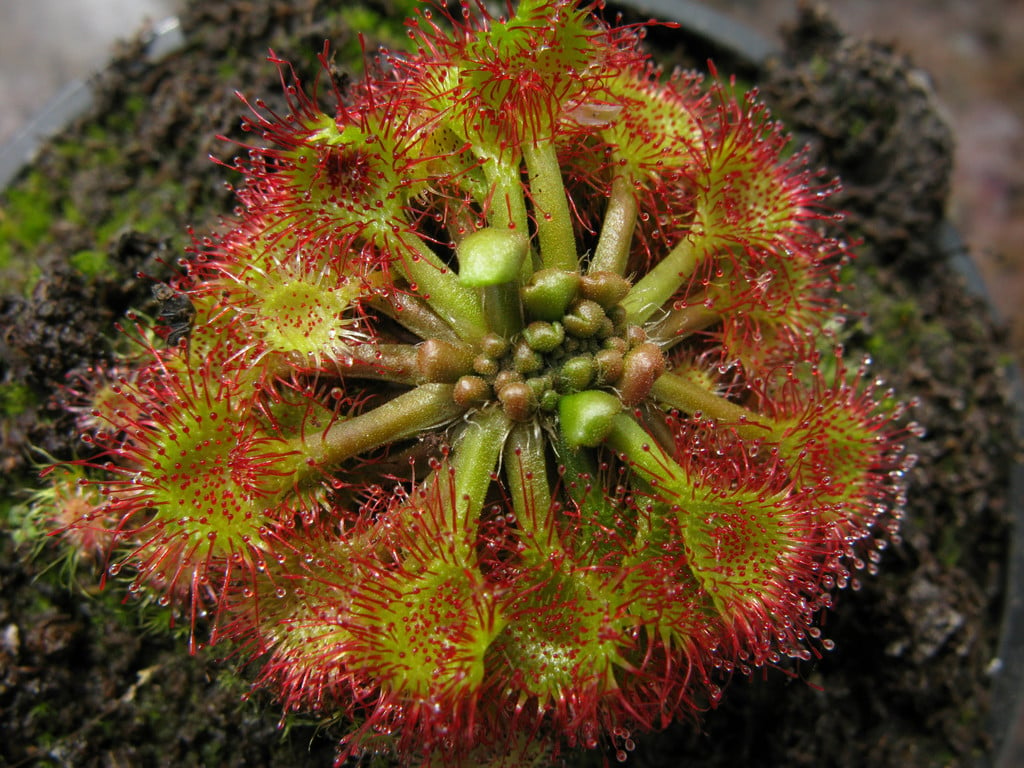
Drosera rotundifolia

RHS Plant Profile
round-leaved sundew
round-leaved sundew RHS

Other common names

common sundew, lustwort, moor-grass, red rot, rosa solis, youthwort, dew plant, eyebright, gwlithlys

Bogs

An insectivorous perennial with long-stalked leaves forming basal rosettes. The almost circular leaves up to 1cm across are covered with sticky, red-tipped, gland-bearing hairs for trapping small insects and are held on horizontally-spreading, hairy leaf stalks 1-5cm long. Small flowers, usually with 5-6 white to pink petals are held on erect, slender, hairless stems up to 15cm tall which emerge from the centre of the leaf rosette in summer

Position

Full sun, Partial shade

Soil Types

Sand

Max Height

0.1-0.5 metres

Max Spread

0.1-0.5 metres

Size

Time to Maturity
1–2 years
Max Spread
0.1-0.5 metres
Max Height
0.1-0.5 metres

Growing Conditions

Sand
Moisture
Poorly–drained
pH
Acid

Position

Full sun Partial shade
Aspect
West–facing or South–facing or East–facing
Exposure
Sheltered
Hardiness
H5

Colour & Scent

Season Stem Flower Foliage Fruit
Spring
Summer
Autumn
Winter

Botanical Details

Family
Droseraceae
Native to GB/Ireland
Yes
Foliage
Evergreen
Habit
Matforming
Genus
Drosera, commonly known as the sundews are one of the largest genera of carnivorous plants. They are perennial or (more rarely) annual, upright herbaceous plants forming either prostrate or upright rosettes, and can live for up to 50 years.
Name Status
Correct
Plant Range
Europe, N Asia

How to Grow

Cultivation

Under glass grow in a mix of equal parts fertiliser-free peat substitute and sand, in full light, although may need shading from hot midday sun in summer. The compost should be kept continually moist to wet during the growing season by standing the container in a tray of lime-free water, such as rainwater. During the winter, plants enter a period of dormancy so keep just moist during the winter and do not stand the plants in water. If growing in a bog garden, plant in good light, but not in direct sunlight. For further information see Carnivorous plant cultivation

Propagation

Propagate by seed as soon as ripe or by division of clumps after flowering. Leaf cuttings during the growing season and root cuttings taken when dormant are alternative methods of propagation

Suggested planting locations and garden types

  • Patio and container plants
  • Wildlife gardens

Pruning

No pruning required

Pests

Generally pest-free

Diseases

Generally disease-free