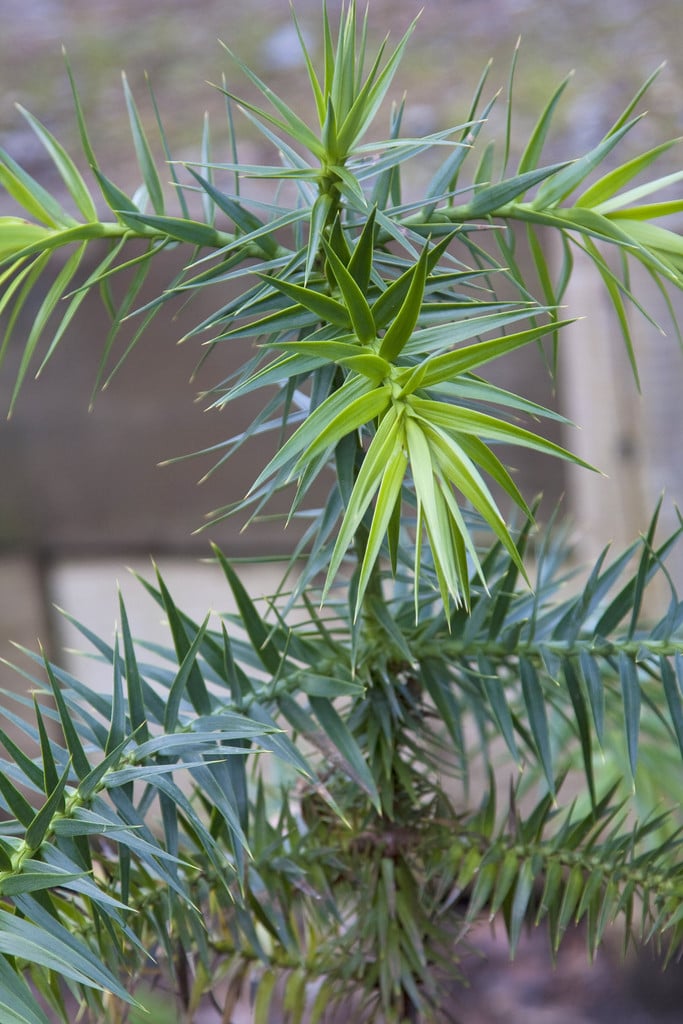
Araucaria angustifolia

RHS Plant Profile
Brazilian monkey-puzzle
Brazilian monkey-puzzle RHS

Other common names

Brazilian pine tree, Paraná pine, candelabra tree

Synonyms

Araucaria brasiliensis

Conifers Trees

A large, evergreen tree with a narrow, pyramidal habit when young, becoming more dome-shaped with age. Thick, triangular leaves, 3-6cm long with sharp edges and tips are arranged spirally on branchlets with those at the outer ends tending to be tufted. Male and female cones are usually borne on separate trees; the male cones are oblong and up to 18cm long whilst the female cones are globular in shape, 18-25cm in diameter, and remain maturing on the tree for up to three years after pollination

Position

Full sun, Partial shade

Soil Types

Chalk, Loam, Sand

Max Height

Higher than 12 metres

Max Spread

wider than 8 metres

Size

Time to Maturity
20–50 years
Max Spread
wider than 8 metres
Max Height
Higher than 12 metres

Growing Conditions

Chalk Loam Sand
Moisture
Moist but well–drained
pH
Acid or Alkaline or Neutral

Position

Full sun Partial shade
Aspect
South–facing or West–facing or East–facing
Exposure
Sheltered
Hardiness
H3

Colour & Scent

Season Stem Flower Foliage Fruit
Spring
Summer
Autumn
Winter

Botanical Details

Family
Araucariaceae
Native to GB/Ireland
No
Foliage
Evergreen
Habit
Bushy
Genus
Araucaria are evergreen trees from the Southern Hemisphere, with whorled branches bearing spirally arranged leaves that may be needle-like, triangular or scale-like, and small male, and large female cones, usually on separate trees
Name Status
Correct
Plant Range
Brazil & Argentina

How to Grow

Cultivation

Grow in moderately fertile, moist but well drained soil; prefers a slightly acidic soil

Propagation

Propagate by seed sown in seedbed as soon as ripe; take semi-ripe cuttings of vertical shoot tips in midsummer and root in a cold frame, cuttings of horizontal side branches will not form an upright tree

Suggested planting locations and garden types

  • Architectural

Pruning

Pruning group 1; little or no pruning is required, as this can permanently spoil the shape of the tree

Pests

Generally pest-free

Diseases

May be susceptible to honey fungus