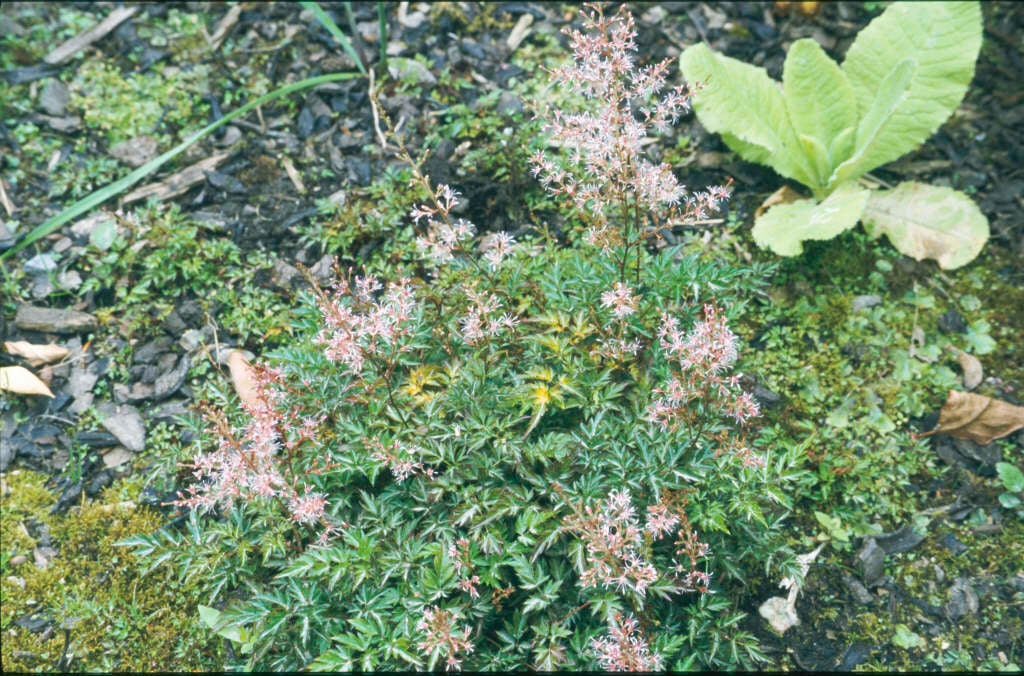
Astilbe glaberrima var. saxatilis

RHS Plant Profile
smooth rock astilbe
smooth rock astilbe RHS 2002

Synonyms

Astilbe (_glaberrima_ × _'Saxosa')
Astilbe japonica 'Saxosa'
Astilbe 'Saxosa'
Astilbe glaberrima saxosa minor
Astilbe glaberrima saxosa

Award of Garden Merit
Bogs Herbaceous Perennial

Dwarf clump-forming perennial about 8cm tall and 15cm wide, with glossy bronze-green, deeply divided leaves, red-tinted beneath, and short sprays of pinkish-mauve tinged white flowers to 10cm long appear above the foliage in summer

Position

Partial shade

Soil Types

Clay, Loam

Max Height

0.1-0.5 metres

Max Spread

0.1-0.5 metres

Size

Time to Maturity
2–5 years
Max Spread
0.1-0.5 metres
Max Height
0.1-0.5 metres

Growing Conditions

Clay Loam
Moisture
Moist but well–drained or Poorly–drained
pH
Acid or Alkaline or Neutral

Position

Partial shade
Aspect
East–facing or West–facing or North–facing
Exposure
Sheltered
Hardiness
H5

Colour & Scent

Season Stem Flower Foliage Fruit
Spring
Summer
Autumn
Winter

Botanical Details

Family
Saxifragaceae
Native to GB/Ireland
No
Foliage
Deciduous
Habit
Clump forming
Genus
Astilbe are rhizomatous herbaceous perennials with attractive, usually ternately divided leaves and erect plume-like panicles of tiny white, pink or purple flowers in summer. The old, brown flower-heads remain attractive in autumn
Name Status
Correct
Plant Range
Japan

How to Grow

Cultivation

Grow in moist or boggy soil in dappled shade, or in indirect sun where the soil remains moisture-retentive in summer. Drought intolerant, may be damaged in hot sun. Good for waterside planting. See Astilbe cultivation

Propagation

Propagate by division in late winter or early spring, pot divisions under glass and plant out in late spring.

Suggested planting locations and garden types

  • Cottage and informal garden
  • Rock garden
  • Flower borders and beds

Pruning

Cut back after flowering

Pests

May be susceptible to vine weevil

Diseases

May be susceptible to powdery mildews